I think I’m almost out of "easy" 5.9 climbs in the Trapps.
I’ve found many more of them lurking there than I expected.
Part of the reason I’ve found so many introductory 5.9’s is that as soon as I climb a 5.9 and find it pretty straightforward, I begin to discount it. I think that if I’ve done it so easily it must be one of the less serious ones. So, when I got through WASP with no problems I began to categorize it in my mind as a former 5.8 and not a legitimate 5.9. The same logic demoted Casablanca. Swain said it’s a 5.8, so it can’t be a “real“ 5.9. Bonnie’s Roof? Obviously it should still be a 5.8+, as it was for so many years…
You can go on and on this way, rationalizing away all of your success stories. The first pitch of Three Vultures? Just a boulder problem, not really worthy of the grade. Pitch three of Keep on Struttin’? Not as hard as pitch two so obviously overgraded.
Apoplexy? Okay, I’m still proud of that one.
Oddly, one place I haven’t found too many easy 5.9’s is in the land of 5.9 minus. One exception is the first pitch of Higher Stannard. When I climbed it I thought it was graded 5.9- appropriately. (It is also one of the best 5.9 pitches I’ve climbed.) Fillipina, by contrast, seemed hard to me. Another 5.9-, Land’s End, is so notoriously hard for its grade (and run out between the cruxes) that I haven’t even dared to try it.
I recently hopped on two more 5.9- climbs that I’d previously dismissed as not worth the trouble. And I was surprised to find they were both pretty good, and pretty much spot-on in terms of their difficulty ratings.
The first one was Red Cabbage. It is a short climb (perhaps 50 feet), squeezed in on the side of the Gerdie Block. It begins just around the corner to the right of the Gerdie climbs, at a vertical crack that goes up about fifteen or twenty feet. The crux comes as you figure out a way to exit the crack at its end and head left around the corner, at which time easier climbing takes you to the top.
I had always assumed this climb had maybe one move on it, and so never found it very appealing.
But recently I was standing there at the end of a nice Saturday full of climbing with Adrian and Maryana. I thought I was pretty much done leading anything of any real difficulty for the day, but then Adrian did a great job leading Retribution (5.10b), and, inspired by his example, I followed it clean.
I decided I was still feeling pretty good and so why not try Red Cabbage?
It turned out to be more than one move’s worth of climbing.
As is usual in the Gunks, the vertical crack is jammable but there are face holds to the right as well, so no jamming technique is really required. The face is steep and the early going is surprisingly pumpy. I wanted some jamming practice so I made sure to try to throw in at least a couple of jams. I got a really good cupped-hand jam about halfway up the crack. I also placed a lot of pro, perhaps unwisely, in quick succession: my # 1, # 2, and # 3 Camalots all went into the crack.
Then at the exit to the crack I had to decide whether to go immediately left or to go a little right (the chalk goes right) before moving up and then left around the corner.
I started to head left but quickly realized it wasn’t happening.
Feeling the pump clock ticking, I headed right, and confronted the move up to what looked like a good horizontal. I kept pawing the key hold, a pebbly ball of rock, with my right hand, wondering if I’d be able to hold onto it as I stepped up to the better horizontal. I hesitated, thinking I just might blow it, but finally clenched the pebbly ball, made the move up, grabbed the good hold, placed a great tricam, and the difficulty was over.
But I wished I hadn’t used all my bigger pieces in the initial crack, because once you’re around the corner you’re at a big horizontal. I didn’t have anything left on my rack that was big enough to place there, so I had to run it out a bit on easy ground.
Reaching the top I decided Rad Cabbage is a totally worthwhile little route. It’s no destination climb but it’s certainly not the waste of time I assumed it would be.
More recently, on my day out with Gail in late August, I had occasion to try out Triangle.
Really the only reason I led it was that I wanted to set up a toprope for us above Never Never Land (5.10a). (Later on I flailed all over the ridiculous crux of Never Never Land, but that’s another story.) I had always assumed that this was the only reason anyone ever climbs Triangle; after the crux it is easy to traverse to the bolts above Never Never Land and several other hard face climbs.
Considered in its own right, Triangle looks unimpressive. The triangular, blocky feature it is named for leans against the main wall of the cliff, offering what appears to be very easy climbing up the right side. Then a little roof awaits above. This roof is the crux. It doesn’t look like much from the ground.
There is a variation to Triangle that Dick Williams recommends in his guidebook, which goes up the center of the face of the triangle, offering a pitch of more sustained 5.9 climbing than the regular route. But I have read that the hard moves on the face of the triangle are poorly protected. So I elected to just do the regular route.
Like Red Cabbage, Triangle surprised me. I thought it was good fun. The climbing up to the roof is easy but enjoyable. Then the roof itself is a good one-move problem. There are several pins just above the roof. I saw at least three; I clipped two of them. It appears that people get above the roof two different ways. I started from the left, stepping up to the obvious undercling block beneath the roof to reach a good hold above. Then a couple pumpy moves right and up took me out of the crux. I noticed as I moved right, however, that the whole right side of the roof seems like a good layback flake hold, which may present another (easier?) way to solve the problem.
Whichever way you solve it, the climbing is clean and the pro is good so long as at least one of the old pins will hold. There’s probably other pro for the crux besides the pins if you stick around to look for it.
Don’t get me wrong; the Triangle crux isn’t the kind of roof that will have you letting out a whoop and an “oh yeah!” But it is a good little route, a nice warm-up for another challenge like Never Never Land, or a casual way to end your day with just a little more good climbing.
Neither Red Cabbage nor Triangle comes close to the greatness of Higher Stannard, the king of the 5.9 minuses. But they’re both good, and far from the waste of time I assumed they might be. And now that I’ve done them, I think I’m just about out of easy 5.9’s to try. I’ll have to stop being such a bore and work on some 5.10’s.
Showing posts with label beta. Show all posts
Showing posts with label beta. Show all posts
Tuesday, September 6, 2011


Friday, September 2, 2011
Fighting With 5.9+: Double Clutch & Jean
I've been writing all year about breaking into 5.9.
It's been going pretty well.
On-sight leading of easier 5.9's in the Gunks has for the most part felt reasonable and good. And working on these harder (for me) climbs has made the easier 5.8 and under climbs feel REALLY easy.
But it's never enough. There are always new frontiers. And I've realized that if I ever want to feel super-solid at 5.9, I have to work on climbs that are harder than 5.9.
I want to feel about 5.9 the way I feel about 5.8.
I recently found out one of my son's classmates has a dad who used to be quite the climber. I was talking to him one day about the Season climbs and I mentioned how scary I thought it would be to lead something like The Fall (5.11a R). And he said he thought he'd led it, "back in the day." On another occasion he told me he'd gotten out to the Gunks for the first time in who-knows-how-long and climbed some easy stuff. I asked him what easy stuff and he told me: MF (5.9).
Yes, MF.
MF, the climb I've been working toward attempting my whole climbing life.
MF, the climb about which John Stannard said if you can climb it, "you can climb anything."
I told him I couldn't believe that MF was his climb for shaking off the rust, and he said "you know, it's a 5.9. There have to be good, positive holds."
I want to feel this way about 5.9.
Hence my effort to find some 5.9+ climbs to try.
Now, 5.9+ is a notorious grade at the Gunks. People frequently claim that the 5.9+ climbs are harder than many 5.10’s. I can’t really say whether these claims are true. I’ve proceeded under the assumption that such claims are false. I know that 5.9 used to be the top of the scale, so many old-school 5.9’s are actually far tougher than the grade would indicate. But the grades in the Gunks have been scrutinized for decades, and changed by the guidebook authors when they thought it appropriate. So when I see a 5.9 in the Gunks, I figure it really is a 5.9.
Over the past couple months, I’ve tried a couple 5.9+ climbs. These were on-sight attempts on lead. And I’m sorry to say that each attempt has been a failure.
The first one I tried was Double Clutch, which sits in a very popular area of the Uberfall, just right of Retribution and Nosedive and left of Doug’s Roof and Horseman. The climb begins at the left end of the huge roof, climbing up to the overhang at about the 5.6 level. Then a traverse with a big horizontal for hands and not much of anything for the feet takes you to a large notch in the overhang. At this notch you have to go for a good horizontal that is rather far away.
The best reason to try Double Clutch is that there is awesome pro for the crux move. There is a big angle piton just to your left, and you can stick a # 4 or # 5 C4 securely in the notch. When I tried to do it I also got a perfect .75 C4 in the back of the notch, right below my # 4. So you can make the move with three bomber pieces at your waist. And the fall is totally clean. You are at the lip of a gigantic roof. Theoretically, you should feel free to go for it, knowing that if you blow it you’ll hit nothing but air.
But even though I knew the pro was good I couldn‘t make myself really throw for the rail with abandon. I kept trying less dynamic strategies to get the hold and none of them worked. I tried getting my feet up and twisting, I tried to work out some sort of heel hooking arrangement, I tried turning my body left and right. I got close but couldn’t quite make it. I was with Maryana at the time. After I gave up, she led up on my gear and couldn’t do it either.
Afterwards I got a lot of beta advice. Gail told me she’s done it by heel hooking and cranking really hard. This sounds like a good approach, but I feel like I tried that already. A friend of Maryana’s told her he solved it by sticking his knee in the notch. I never considered this method. It won’t work if you’ve already filled the notch with a big cam. And it sounds like a sure path to an ugly injury if you fail to stick the grab! This same person also said that throwing for the good hold is the method for “idiots.”
And maybe it is. But when I look back on it, my big regret is that I didn’t just let go and throw for it. I wish I’d had the guts to do it once. I really want to go back and try it. It would be great fall practice, with zero consequences. And I’ll probably nail the dyno, I just have this feeling about it.
A couple weeks ago I was belaying Adrian on Retribution and saw an older guy walk up and solo Double Clutch, going up the harder direct start straight up to the cleft. This guy was not the most svelte specimen; let’s just say it’s probably been several years since the prime of his climbing career. I imagined he was an old-school hero of mine whom I failed to recognize. From my position I couldn’t see exactly what he did. But I was watching as he made the crux reach and the key, it seemed to me, was the dynamic nature of his movement, the momentum he had as he just flowed through the move, secure in the knowledge his little, unroped push would go just the right distance to the horizontal. He certainly didn’t use a heel hook or any knee trickery.
I’m not endorsing his soloing, necessarily. That’s a different subject. But the confidence, the dynamic movement-- these I need to copy. They are the first things that desert the skittish leader. Going back to Double Clutch and forcing myself to go for it might be really helpful.
On August 20, I was out with Gail and decided for some reason to try Jean. This was late in our climbing day. We’d already done a bunch of pitches and I was feeling tired. I had started to propose that we do something easy, maybe a classic 5.5 or 5.6 to warm down, but then somehow I ended up bringing up this hard roof problem climb and Gail, being the supportive person that she is, encouraged me to give it a try.
And so I found myself standing beneath Jean, racked up and ready to go. As I headed upward, I quickly knew that I wasn’t at my best. About halfway up there is this one dicey move left to the shallow corner that is followed to the roof. I had good pro for this move but I went back and forth a couple times before I could commit to it. I was climbing scared, feeling weak.
Then at the roof, I found an irregular pocket that formed the only handhold directly under the overhang. I wanted to stick a piece into this pod, but I found it impossible. I couldn’t reach the pocket without grabbing it, and once I grabbed it I couldn’t stick anything in. Up and down I went, exploring, looking for other gear at the roof level, even pawing around above the roof, but finding none.
I’d been unsure about whether I could do this climb before I even tried it. But I had assumed I’d find protection at the roof. Instead I’d only found a piece a few feet below. I don’t mean to dwell on my accident from nearly two years ago, but it’s hard not to think about it when you are faced with the prospect of blowing it right above a roof, with the only pro being a few feet below the overhang. I’ve seen that exact movie before. It ends in a big, swinging fall, and a broken ankle. I’m trying my best not to go there again.
Holding on there, examining the roof on Jean, I wasn’t willing to continue without more pro. So I stepped down to my last piece and asked Gail to take.
So much for the onsight.
Once I decided to hang on the rope, I looked around for other pieces to place, but all I could work out was a good .5 Camalot in the crack running sideways through the underside of the roof. This piece was higher than my last one, which was a good thing, but it was off-line and to the right. I had to extend the runner on the piece, making it not that much better than the piece below.
Thinking it over, I decided I just didn’t have a good feeling about the way Jean was going. So for the first time in my checkered climbing career, I decided to bail on the lead. I didn’t even try to pull the roof.
I knew Gail hadn’t signed up to lead Jean either, so I would have to lead up something else and traverse over to get my gear. Sixish seemed like the obvious choice. I hoped to traverse directly to the fixed anchor above Jean, but it turned out that Sixish comes around the corner onto the Jean face about ten feet above the Jean anchor. I ended up building a three-piece rig from which Gail could lower me to the gear I’d left behind. (This took forever; sorry, Gail.)
Once I recovered my gear I had to climb the Jean crux on toprope to get back up to my improvised traverse. I’m happy to say I got it done on the first try. It even made me wish I’d gone ahead and led it, because what makes the Jean crux difficult is the initial holds just above the roof, which aren‘t as positive as you‘d like them to be. Just above these is a great jug, and once you‘ve got the jug, you‘re not going to blow it. So it seems to me the fall on Jean wouldn‘t be so bad after all, since it would happen (if it happened) before the roof was pulled.
I later found out from an old thread on Gunks.com that there used to be a fixed Ball Nut at the pocket below the roof. I have neither Ball Nuts nor Ball Nut skillz, but I now think I could safely lead Jean, and probably not blow it. I would have to get a move on and not get pumped out in the moves up to the roof, place the pro I got last time, and then bust it up to the jug.
I started attempting these 5.9+ climbs in order to make the 5.9’s feel easier-- the way MF felt to the dad of my son’s friend. I don’t think the effort has so far been successful. But it has made me hungry. I am resolved to go back to these climbs this year and storm right up them. Whether it leads to success or failure, I won’t be happy until I throw for the horizontal on Double Clutch and try to pull the Jean roof on lead.
It's been going pretty well.
On-sight leading of easier 5.9's in the Gunks has for the most part felt reasonable and good. And working on these harder (for me) climbs has made the easier 5.8 and under climbs feel REALLY easy.
But it's never enough. There are always new frontiers. And I've realized that if I ever want to feel super-solid at 5.9, I have to work on climbs that are harder than 5.9.
I want to feel about 5.9 the way I feel about 5.8.
I recently found out one of my son's classmates has a dad who used to be quite the climber. I was talking to him one day about the Season climbs and I mentioned how scary I thought it would be to lead something like The Fall (5.11a R). And he said he thought he'd led it, "back in the day." On another occasion he told me he'd gotten out to the Gunks for the first time in who-knows-how-long and climbed some easy stuff. I asked him what easy stuff and he told me: MF (5.9).
Yes, MF.
MF, the climb I've been working toward attempting my whole climbing life.
MF, the climb about which John Stannard said if you can climb it, "you can climb anything."
I told him I couldn't believe that MF was his climb for shaking off the rust, and he said "you know, it's a 5.9. There have to be good, positive holds."
I want to feel this way about 5.9.
Hence my effort to find some 5.9+ climbs to try.
Now, 5.9+ is a notorious grade at the Gunks. People frequently claim that the 5.9+ climbs are harder than many 5.10’s. I can’t really say whether these claims are true. I’ve proceeded under the assumption that such claims are false. I know that 5.9 used to be the top of the scale, so many old-school 5.9’s are actually far tougher than the grade would indicate. But the grades in the Gunks have been scrutinized for decades, and changed by the guidebook authors when they thought it appropriate. So when I see a 5.9 in the Gunks, I figure it really is a 5.9.
Over the past couple months, I’ve tried a couple 5.9+ climbs. These were on-sight attempts on lead. And I’m sorry to say that each attempt has been a failure.
The first one I tried was Double Clutch, which sits in a very popular area of the Uberfall, just right of Retribution and Nosedive and left of Doug’s Roof and Horseman. The climb begins at the left end of the huge roof, climbing up to the overhang at about the 5.6 level. Then a traverse with a big horizontal for hands and not much of anything for the feet takes you to a large notch in the overhang. At this notch you have to go for a good horizontal that is rather far away.
The best reason to try Double Clutch is that there is awesome pro for the crux move. There is a big angle piton just to your left, and you can stick a # 4 or # 5 C4 securely in the notch. When I tried to do it I also got a perfect .75 C4 in the back of the notch, right below my # 4. So you can make the move with three bomber pieces at your waist. And the fall is totally clean. You are at the lip of a gigantic roof. Theoretically, you should feel free to go for it, knowing that if you blow it you’ll hit nothing but air.
But even though I knew the pro was good I couldn‘t make myself really throw for the rail with abandon. I kept trying less dynamic strategies to get the hold and none of them worked. I tried getting my feet up and twisting, I tried to work out some sort of heel hooking arrangement, I tried turning my body left and right. I got close but couldn’t quite make it. I was with Maryana at the time. After I gave up, she led up on my gear and couldn’t do it either.
Afterwards I got a lot of beta advice. Gail told me she’s done it by heel hooking and cranking really hard. This sounds like a good approach, but I feel like I tried that already. A friend of Maryana’s told her he solved it by sticking his knee in the notch. I never considered this method. It won’t work if you’ve already filled the notch with a big cam. And it sounds like a sure path to an ugly injury if you fail to stick the grab! This same person also said that throwing for the good hold is the method for “idiots.”
And maybe it is. But when I look back on it, my big regret is that I didn’t just let go and throw for it. I wish I’d had the guts to do it once. I really want to go back and try it. It would be great fall practice, with zero consequences. And I’ll probably nail the dyno, I just have this feeling about it.
A couple weeks ago I was belaying Adrian on Retribution and saw an older guy walk up and solo Double Clutch, going up the harder direct start straight up to the cleft. This guy was not the most svelte specimen; let’s just say it’s probably been several years since the prime of his climbing career. I imagined he was an old-school hero of mine whom I failed to recognize. From my position I couldn’t see exactly what he did. But I was watching as he made the crux reach and the key, it seemed to me, was the dynamic nature of his movement, the momentum he had as he just flowed through the move, secure in the knowledge his little, unroped push would go just the right distance to the horizontal. He certainly didn’t use a heel hook or any knee trickery.
I’m not endorsing his soloing, necessarily. That’s a different subject. But the confidence, the dynamic movement-- these I need to copy. They are the first things that desert the skittish leader. Going back to Double Clutch and forcing myself to go for it might be really helpful.
On August 20, I was out with Gail and decided for some reason to try Jean. This was late in our climbing day. We’d already done a bunch of pitches and I was feeling tired. I had started to propose that we do something easy, maybe a classic 5.5 or 5.6 to warm down, but then somehow I ended up bringing up this hard roof problem climb and Gail, being the supportive person that she is, encouraged me to give it a try.
And so I found myself standing beneath Jean, racked up and ready to go. As I headed upward, I quickly knew that I wasn’t at my best. About halfway up there is this one dicey move left to the shallow corner that is followed to the roof. I had good pro for this move but I went back and forth a couple times before I could commit to it. I was climbing scared, feeling weak.
Then at the roof, I found an irregular pocket that formed the only handhold directly under the overhang. I wanted to stick a piece into this pod, but I found it impossible. I couldn’t reach the pocket without grabbing it, and once I grabbed it I couldn’t stick anything in. Up and down I went, exploring, looking for other gear at the roof level, even pawing around above the roof, but finding none.
I’d been unsure about whether I could do this climb before I even tried it. But I had assumed I’d find protection at the roof. Instead I’d only found a piece a few feet below. I don’t mean to dwell on my accident from nearly two years ago, but it’s hard not to think about it when you are faced with the prospect of blowing it right above a roof, with the only pro being a few feet below the overhang. I’ve seen that exact movie before. It ends in a big, swinging fall, and a broken ankle. I’m trying my best not to go there again.
Holding on there, examining the roof on Jean, I wasn’t willing to continue without more pro. So I stepped down to my last piece and asked Gail to take.
So much for the onsight.
Once I decided to hang on the rope, I looked around for other pieces to place, but all I could work out was a good .5 Camalot in the crack running sideways through the underside of the roof. This piece was higher than my last one, which was a good thing, but it was off-line and to the right. I had to extend the runner on the piece, making it not that much better than the piece below.
Thinking it over, I decided I just didn’t have a good feeling about the way Jean was going. So for the first time in my checkered climbing career, I decided to bail on the lead. I didn’t even try to pull the roof.
I knew Gail hadn’t signed up to lead Jean either, so I would have to lead up something else and traverse over to get my gear. Sixish seemed like the obvious choice. I hoped to traverse directly to the fixed anchor above Jean, but it turned out that Sixish comes around the corner onto the Jean face about ten feet above the Jean anchor. I ended up building a three-piece rig from which Gail could lower me to the gear I’d left behind. (This took forever; sorry, Gail.)
Once I recovered my gear I had to climb the Jean crux on toprope to get back up to my improvised traverse. I’m happy to say I got it done on the first try. It even made me wish I’d gone ahead and led it, because what makes the Jean crux difficult is the initial holds just above the roof, which aren‘t as positive as you‘d like them to be. Just above these is a great jug, and once you‘ve got the jug, you‘re not going to blow it. So it seems to me the fall on Jean wouldn‘t be so bad after all, since it would happen (if it happened) before the roof was pulled.
I later found out from an old thread on Gunks.com that there used to be a fixed Ball Nut at the pocket below the roof. I have neither Ball Nuts nor Ball Nut skillz, but I now think I could safely lead Jean, and probably not blow it. I would have to get a move on and not get pumped out in the moves up to the roof, place the pro I got last time, and then bust it up to the jug.
I started attempting these 5.9+ climbs in order to make the 5.9’s feel easier-- the way MF felt to the dad of my son’s friend. I don’t think the effort has so far been successful. But it has made me hungry. I am resolved to go back to these climbs this year and storm right up them. Whether it leads to success or failure, I won’t be happy until I throw for the horizontal on Double Clutch and try to pull the Jean roof on lead.
Wednesday, August 3, 2011
Climbing at Rogers Rock: Little Finger (5.5)

(Photo: View of Rogers Rock from Lake George.)
I have long dreamt of rock climbing in the Adirondacks.
But until recently I could never work it out to climb up there at all. It has always seemed impractical. It is too far for a day trip from NYC. And when I get the opportunity for several days of climbing in a row, I always end up picking more glamorous destinations that are further away, like Red Rocks.
This summer, however, I finally got my chance.
My wife's good friend Greg has owned a house on Lake George for the past few years, and we planned a weekend in early July when my family could visit his family there.
As we prepared for this visit, I tried to sell Greg on the idea of climbing with me up the classic 500 foot, three-pitch route Little Finger (5.5), which ascends Rogers Slide, the slabby east face of Rogers Rock. The route would be easy for us both, I told him.
I was really psyched about climbing in such a beautiful setting, on a cliff that rises straight out of the lake. Another bonus is that the route requires an approach by boat. I knew that Greg owns a small motorboat so I thought this would be easy for us to manage as well. I figured it would be a quick ride to the cliff from his house near Bolton's Landing. We could tie up the boat, run up the route, and be be back before our wives and children even noticed we were gone.
Over the months during which I've been proposing this little adventure, Greg has made supportive noises, but I wasn't sure he was entirely serious about doing the climb with me until just before our visit. I told Greg I had a harness, a helmet and a belay device for him, but that if we were going to do the climb he'd need to get some climbing shoes. I was thrilled when he actually went to Paragon and bought a pair of La Sportivas. I could hardly believe it. We were really in business.
Now as you may have gathered, Greg is not a climber, although he has worn a harness before, and has even belayed a few times in a gym setting with an ATC. Prior to our day on Rogers Rock he'd never climbed outside.
When I talked up the climb to Greg, I always emphasized how safe we'd be. I told him he'd always be on toprope, and that I'd build super-safe anchors for us. I also told him that this climb was very easy and that there was basically no way that I would call upon him to catch me falling on it.
I said these things because I wanted him to feel like doing this route with me would be a safe, reasonable thing to do. So I had a selfish interest in saying them: I wanted Greg to agree to do the climb. But I wasn't trying to sell Greg a bill of goods. I really did believe the climb would be easy for us. It is 5.5, after all.
The only hint of concern I had at the back of my mind as I reassured Greg was that Rogers Rock features slab climbing, which is not my strong suit. I have very little experience in slab and I don't feel very secure in the discipline. But the guidebook says that Little Finger is not typical of the slab routes on Rogers Slide, in that it follows a vertical crack which provides great pro and positive holds.
With that information I felt fine about our prospects.
When our weekend visit arrived, it looked like we were going to have perfect conditions. It was rainy towards the end of the week but the forecast was good for both Saturday and Sunday. I proposed that we climb on Sunday so as to have the best chance for dry rock; also we could plan out our logistics on Saturday and prepare. The day before the climb I had Greg try on my spare harness, and I gave him a quick primer on making sure the harness was doubled back. Then I gave him a refresher on belaying with the ATC and told him the few things he'd have to remember on the climb:
1. Feed me enough rope-- do not pull me off of the rock!
2. Never let go of the brake strand.
3. Do not take me off the belay until I say "off belay."
4. DO NOT DROP YOUR ATC!!
After just a little practice I felt like we were good to go.

(Photo: approaching Rogers Rock by boat in the early morning)
We got an early start on Sunday, leaving the Bolton's Landing area by 6:30 a.m. I wanted to get there early to make sure we were the first party on the wall, and to ensure we didn't take up too much of the day.
There was a slight wrinkle that arose from the fact that I know nothing about boats.
I was assuming Greg and I would just park the motorboat somehow and leave it at the base of Rogers Rock. It turns out that this is impractical. Typically people approach by canoe or rowboat and pull the boat up onto the small bit of land that sits at the base of the cliff. Greg's motorboat is too heavy for that, and apparently-- who knew??-- if there is no place to moor the boat it can't just be left unattended at the base. So Greg's wife Peggy had to get up early to drive us in the boat to the rock. (Sorry, Peggy.)
We left our return plan tentative. Luckily there is pretty good (Verizon) cell phone coverage at Rogers Rock. We decided we'd call Peggy later and tell her whether we were going to rappel (meaning we'd need a pick-up by boat) or top out and walk around to the campground (requiring pick-up by car). Greg and Peggy had both heard from locals that people usually top out and walk off after climbing Rogers Rock. Greg preferred the idea of walking off to rappelling, but I was skeptical that topping out would be practical from Little Finger. This idea about walking off was just one of several things they had heard from neighbors about climbing on Rogers Rock, and I didn't have to climb on the rock to know some of the other things they'd heard were false. For instance, they had also been told that the whole route is protected by fixed pitons, a notion I knew to be ridiculous.
I read in the guidebook that the original Little Finger route had gone all the way up, and I saw from the topo that some other less-frequently climbed routes on Rogers Slide do actually top out. But I also knew that Little Finger as it is now typically done stops after three pitches, well short of the top. It is unmarked in the guidebook past the rap anchor atop pitch three. I told Greg that if I saw an obvious scramble to the top I was all for it, but I suspected we'd be rapping off.
The water was calm as we approached Rogers Rock and we had no trouble jumping out of the boat and onto the rocks at the base with my big backpack. I quickly got my rack and ropes out and tossed my pack back into the boat. ("You have to bring all that crap with you?" Peggy asked.) And then, after a tiny bit of engine trouble, Peggy motored away and we were alone at the base of the cliff.

(Photo: My inexperienced but totally trustworthy partner Greg. Reader, I belayed him.)
The start of Little Finger is easy to find. A little to the right of center of the huge slab, the unmistakable vertical crack of Little Finger seems to rise forever. As I stood there beneath it, the angle seemed reasonable and the crack looked very positive. I was very excited to get going. (Peggy later said that in the boat I'd seemed like "a kid in a candy store.")

(Photo: Trying to look heroic at the base of the climb. You can see the vertical crack of Little Finger rising just to my left.)
The first pitch is only 5.4. It is long, though: 180 feet. The guidebook claims, accurately, that after some early difficulties, the angle and the climbing ease as you head up to the anchor.
As I ascended the early bits, I felt a little tentative. A number of things were roaming around in my brain.
I didn't want to burden Greg with too much gear removal, so I tried to limit the amount of pro that I placed, and I avoided placing many nuts. It killed me to eschew the nuts, since the route follows a vertical crack. So I had to place a few. This climb eats nuts! But I tried my best to avoid it. And since I was placing mostly cams, I had to run it out a bit in order to conserve them, which made even easy moves seem serious.
Also, the fall I'd taken just the previous Tuesday on Ground Control (5.9) in the Gunks couldn't help but enter my mind. My confidence was a little shaken, and the two fingers I'd sprained on my right hand were still rather swollen. I tried not to use them. On such easy climbing it was usually no problem, but it still required some mental effort.
Finally, I don't think I was climbing the route terribly well. I'm sure I could have pasted one foot on the slab at all times and comfortably walked up the stupid thing. Instead, since even easy slab climbing scares the crap out of me, I basically crack-climbed it, keeping my hands and feet in the crack almost all the time. This forced my body into positions that, while secure, were likely more awkward than necessary.
Eventually, I just admitted to myself I was a little nervous, stopped and placed a cam, and rested. Then I got over it, resumed climbing, and everything was fine.

(Photo: Looking down pitch one of Little Finger (5.5).)
As I neared the first belay station, at a slightly lower-angled scoop in the rock, I began to really enjoy the climb and the beautiful surroundings. The rock was good and the view was spectacular. There was pro available in the vertical crack pretty much whenever I might want it. The day was pleasant, sunny and not too hot.
I reached the belay and found a fixed cordelette tied to a nut and a couple pitons. I used this station as one leg of a three-piece anchor, adding two cams of my own to make the anchor crazy-solid.
"Greg," I shouted. "I'm off belay."
I watched as Greg took the ropes out of his ATC.
Then he violated rule number 4.
"Uh oh, I dropped the ATC!"
Oh crap.
I envisioned bringing him up and having to give him my device, and then belaying him with a Munter hitch for the rest of the climb. Then I'd have to take the device back, lower him off from the top of the climb, and rap down to him...
"Can you reach it?" I asked. "Did it go in the lake?"
"It didn't go in the lake, but I can't reach it."
We had only about ten feet of rope left to play with, and it wasn't enough for him to walk down to where the ATC was sitting. I had tied Greg in; he didn't know how to tie a rewoven figure eight knot for himself. I didn't see a safe way for him to escape the system and retrieve the device. I was about to tell him to just forget about the device when he came up with the obvious solution.
"I'm going to get out of the harness for a sec and go grab it."
This was perfect. He knew how to double his harness back; he'd done it himself already before we got started. I knew I could trust him to do it right.
Once he got the device and put his harness back on, he did fine. He climbed the pitch and removed all the gear, looking for all the world like someone with much more experience. No falls or hangs.
Pitch two was shorter, 140 feet, with a 5.5 bulge not far off the anchor. Probably I was just more relaxed, but this pitch seemed easier than the first one to me, and Greg felt the same way. I even busted out a few slab moves on this pitch. The early bulge was easily surmounted and then lower-angled climbing led to a small stance below a roof, where there is no fixed gear. I built a three-piece gear anchor in a couple good cracks.

(Photo: Looking down pitch two of Little Finger (5.5).)
Again Greg had no trouble following the pitch or cleaning my gear.
As he followed pitch two I looked at the pitch three alternatives. The usual finish to the climb heads right from the second belay, continuing to follow the vertical crack, diagonally avoiding the roof, and then heading up to the finish. It is another long pitch of 5.5, 180 feet.
The original finish heads straight up over the roof instead of heading right. It is a more difficult alternative, rated 5.7+. The guidebook describes this as the best pitch on Rogers Slide, and says it is well-protected. Once over the roof the pitch heads straight up and eventually moves right to the same finishing anchor employed by the 5.5 finish.
I was aware that some leaders will place a piece at the overhang as a "French free" alternative for partners who are not up to free-climbing the overhang. The second can then pull on the gear to get through the crux. I felt sure we'd have no problem with the roof pitch, but I decided not to push Greg. He was doing very well, and seemed to be hiding any fear he was feeling, but I wanted him to finish the day with an air of accomplishment, not failure. 500 feet of 5.5 was probably a big enough test for him today.

(Photo: View of Lake George from the top of pitch two of Little Finger (5.5).)
So I told Greg I thought we should just do the 5.5 regular finish, and he seemed relieved.
It turned out that the first part of the third pitch, even when you go the easier 5.5 way, is still the crux of the whole route. There is a traverse on good but slabby feet (the mental crux) and then a couple steep steps up (the physical crux) before the angle eases again, leading to cruiser climbing to the finish.
There isn't too much gear for the traverse, but I tried to place as much as I could. I warned Greg about the swing potential. There is bomber gear before you move much sideways (I think I placed two pieces after I left the belay), and then it is a couple steps to the end of the overhang on the right before you get anything again. Before moving upwards through the physical crux moves you can get a great cam over your head. After those moves it is an enjoyable romp up the rest of the way to the bolted final anchor.
I could tell as I was doing the crux moves that this part of the climb might be tough for Greg, so I tried to talk to him about exactly what I was doing as I did it, and pointed out some of the holds I was using.
Once I reached the anchor I could no longer see Greg down below the roof, so I could only cross my fingers and wait. As he began the pitch I breathed easier with each inch of rope I pulled in. After a couple minutes he shouted up that he thought he might fall, but as I looked down I was relieved. I could see his hand, which meant he'd cleared the traverse, so even if he fell there wouldn't be any dangerous swinging. He'd fall a foot or two at most.
And as it turned out he didn't fall. He managed to pull through the crux and finish the climb without a single fall or hang. And, even more amazing to me, we didn't leave any stuck gear. Greg was a great partner. I'd take him along again on a climb in a heartbeat.

(Photo: rapping off.)
From the bolts atop pitch three I could tell there was no easy way to the summit. Up above was a big overhang. It wasn't too far to a bushy gully on the right end of the slab, but it did not appear to me that there was a trail over there.
Once Greg joined me at the anchor, however, I thought it was worth a look, so I had him put me back on belay and I went right to the gully just to check it out. I found a lot of loose rock on the little ledges heading over to the gully. And once at the gully I saw that it is very steep with enormous exposure. It would not be at all difficult to slip and fall hundreds of feet. With no obvious trail to the summit in sight, I went back to the belay and told Greg I thought we should call the wives and tell them to pick us up by boat. We would be rapping off.
And even though rappelling wasn't Greg's first choice, I think it was the much more convenient escape, and a much sexier one besides. Three double-rope raps to the lakefront and a waiting motorboat? That is some serious James Bond action! It sure beats a slog down a long, hot trail to a parking lot.
Later that day at Greg's local beach on the lake, his neighbors seemed shocked and delighted that we'd actually climbed Rogers Rock just like we said we would. Greg too seemed to have had a positive experience. I don't think Greg's climbing shoes will be seeing too much more use, however. He repeatedly described the climb as something he's really happy to be able to say he did once, and only once.
I told him our next target should be Deer Leap, another cliff on Lake George that the guidebook authors describe as the "biggest chosspile in the Adirondacks." With an endorsement like that, how can we resist?
Thursday, July 28, 2011
Gunks Routes: Ground Control (5.9) & The Main Line (5.8)
"Falling!"
How I wish I never had to utter the word.
My week of vacation in New Paltz came to a somewhat sour ending: my first real lead fall of the year, and a minor injury.
Was it really just a few days earlier that I was out with my new partner Parker, sending 5.9's without a hitch?
After our day climbing together, we both had problems. On Parker's next day out he took a surprise lead fall low on WASP (5.9) and hit the ground. He wasn't hurt but now he's spooked and doesn't want to lead anything hard until the weather cools. He blames the heat.
On my next day out, I was with Liz and didn't try anything as hard as 5.9 or 5.10-- well, at least, not on purpose-- but I dealt with some interesting challenges that left me questioning my route finding skills and my overall judgment. Who knows, maybe the heat was a factor for me as well.
Then on the final morning of my vacation, July 5, I was planning to get just a few pitches in with Vass. He and his family had spent the night with us in our vacation rental on their way to their own rental house in the Catskills, and Vass and I planned to get a half day's climbing in before we all left the New Paltz area.
I proposed we head down to the far side of the Nears, because to my shame I'd never been down there at all. I'd never gone past the rotten middle of the Near Trapps; I believe the furthest I'd ventured down the cliff was Up Yours (5.7), last summer. I really wanted to go to the far end to do The Main Line (5.8), a three-star classic. And I was sure we'd find other good climbs to do as well; Williams' most recent guide identifies a whole bunch of other star-worthy climbs in the same area in the 5.7 to 5.9 range.
To get down to The Main Line, we hiked over the top of the Nears on the Millbrook Ridge Trail. It is a nice trail, well blazed with excellent views. After 15 minutes or so on the official trail we found it easy to spot the informal, unmarked trail down the gully to the end of the Near Trapps. From there it was an easy walk to the base of The Main Line.
But The Main Line was wet at the top of the corner that is ascended by the first pitch. I should have expected this, as Williams says in his book that the climbs around The Main Line stay wet for several days after it rains. And it had rained pretty much all day two days before.
We started to look around for an alternative, and quickly found one right next door: Ground Control (5.9).
Ground Control has a 5.8 first pitch, which ends at the same bolted station as pitch one of The Main Line. It appeared to be dry. Dick gives Ground Control two stars, so I thought we may as well give it a go.
I found the first pitch very awkward and not that enjoyable. The first moves are 5.7-ish and go straight up to a horizontal crack beneath a long overhang. I didn't know this at the time, but I later learned that Swain gives this part of the pitch an R rating. Williams gives it a PG and I think I agree with him. I got a good small cam (green C3 if I'm not mistaken) in a horizontal just a couple moves up, and then a bomber green Alien below the overhang.
Once the overhang is reached, the pitch follows a strenuous traverse to the left end of the long roof. The reason the traverse is strenuous is that the good footholds are a little higher than you'd like them to be. It might be less strenuous to ignore these footholds and smear your feet below. But this would likely also be less secure. I placed a great large cam in the middle of the traverse (thank you, yellow Camalot!), and then thought the move up to the stance above the overhang was no big deal. Dick calls this move the crux, but for me the crux was the traverse that came before.
I thought the rest of the pitch was easier than 5.8. It ascends a slab above the roof to a ledge with a bolted anchor. From the stance above the roof you diagonal to the right, crossing another little corner, continuing almost to the far right edge of the slab, where you find decent holds to take you up diagonally left to the bolts.
All this zig-zagging-- left, then right, then left again-- makes for an ocean of drag. Or it did for me, anyway. We were using my single rope. Doubles might help but if you aim to protect the traverses in this wandering pitch I think some drag is unavoidable. By the end of the pitch I felt like I was hauling an elephant behind me. I was really grateful to get to the bolts and even more grateful once Vass began climbing and removed a few of my protection pieces so that pulling the rope was no longer a tortuous exercise.
As I waited for Vass I stared straight up at the huge overhang that makes up pitch two of The Main Line. It was dry and it looked amazing, following a notch up and right through imposing, beautiful orange rock.
When Vass got to the anchor I asked him if he wanted the lead.
"I don't know, man," he said. "It looks really difficult from here."
"Yes, but it's 5.8, so you know it's jug city up there!" I replied.
Vass was happy to let me be the one to test this optimistic theory. He gave me the lead.
It turned out I was was right. It is jug city.
There are great holds all the way up. The crux is at the bottom of the overhang. Getting the jug above the first lip and stepping up are the hardest parts of the pitch.
There is great pro over your head for the crux move, in the big pod right in front of your face as you reach for the jug above. You can get a nice big cam in there (thank you, yellow Camalot!). It goes in at an angle, but I thought it was totally bomber.
Once you pull up into the overhangs, it remains steep, but there are great holds and pro, and the pitch is over quickly, maybe a little too quickly. It is my only criticism of the pitch: it is a bit short. But this is a quibble. It is a great pitch nonetheless. I'd really like to go back and do pitch one.
When we rapped back to the chains above pitch one I gave the 5.9 second pitch of Ground Control a good hard look. It angles left up the slab above the bolts, going up into a right-facing corner. Then you move left out to the outside corner and (crux) around on to the face. From below, the crux looked airy and exposed. It also looked like there'd be a good cam placement in a downward-facing pod just before the crux. And it appeared a fall from there would be clean, into air beneath the corner.
I thought it was worth a try.
So I headed up and placed a bomber cam (thank you, yellow Camalot!) at the base of the right-facing corner. Then I reached up into the corner and realized that the right face of the corner, which I hadn't been able to see from the bolts, was wet.
Reaching for a wet crimp with my right hand, I found it slimy, but it seemed like I could hold on to it. I just needed to step up into the corner. I never really considered bailing. It looked like there were dry holds at the top of the corner, and a tantalizing fixed nut. I would make one move, clip the fixed nut, and then move left into dryness.
I got a foot up and locked off on the slimy crimp, reaching with my left hand for the holds at the top of the corner.
But just like on Raunchy a few days before, I got my foot tangled in a sling. It was the same sort of move too, stepping up a little high into a corner that sticks out a little from the wall, with gear right below the base of the corner. Again it was not at all the crux of the pitch. I don't know why I've suddenly had this problem twice in one week, but I really need to sit down and sort out the spatial aspects of it before it ever happens to me again. It is such a klutzoid thing to do. I've been leading for years, and I should know better than this. It is completely unacceptable.
This time it wasn't the immediate cause of a fall, but I think it contributed to what happened next.
I cleared my foot. But as I reached up with my left hand for the dry holds, my right hand started to slip off the slimy crimp. And then I knew I wasn't going to stay on. Had I not had to deal with the foot issue, I might have smoothly reached up and had it made. I'll never know for sure.
"Falling!" I yelled.
I didn't fall far; I had just moved my feet above the level of my last protection. But as I got entangled on the way up, so I got entangled on the way down. My foot caught the sling below and I flipped over onto the slab, several feet below the corner and my bomber yellow Camalot, which held fast and true.
I really can't thank that yellow Camalot enough. If I have to fall on something, let it be that #2 yellow Camalot every time. You could hang a limousine off that thing. I am filled with warm love every time I place that big ol' bugger.
"You okay?" Vass asked.
"Yeah, I think I'm fine," I said, righting myself. "Oh, crap. I think I sprained my ring finger."
I have no idea how it happened. I can only guess that my right hand smacked the wall as I fell. As I turned myself right-side-up, I could tell the finger was starting to swell. As I tested it for tenderness, I realized that I'd actually sprained not one but two fingers, the ring finger and the pinkie. It didn't seem like I'd broken any bones, but both fingers were swelling up and becoming painful to bend.
Luckily we were at a set of bolts. I moved the few feet over to the anchor and Vass quickly climbed up and down to recover my gear. Then we rappelled out of there.
It has now been three weeks since this incident, and while the swelling has gone down, for the most part, the two sprained fingers are still not back to the way they were. They are a little swollen at the first joint and don't have the full range of motion that they should. I've been trying to take it easy on them, but I haven't totally stopped going to the gym. When I boulder in the gym I find that I can use them, even though I often feel like I shouldn't.
In a way the injury came at a convenient time. It has been brutally hot and we've had a variety of summer weekend family plans so I haven't yet even considered going back to the Gunks. I am planning on being there next on August 13 with Adrian, and I'm hoping that by that time the fingers will feel pretty normal.
I worry, though, that this fall will set me back, and not just physically.
I worry that it will mess with my lead head. There's no way to know if it will. I know that I'm in much better condition than I was the last time I injured myself in a fall, and I hope as a result I won't suffer the same crisis of confidence this time around.
In an effort to avoid mental breakdown, I'm trying to see this incident in a cold, intellectual light, as something to learn from. The lessons are pretty easy to spot.
For starters, I need to watch my feet and their relationship with the slings and the rope. The more I think about it the more instances I can think of in which I've been surprised to find I need to clear my leg away from the rope. Some of my partners seem instinctively to keep their legs out from behind the rope, while mine always seem to be creeping towards the wrong side. I need to bring a new vigilance toward avoiding this problem.
I also should be more alert to potential trouble ahead and quicker to back off. There is no shame in abandoning a pitch. I never really considered backing off of Ground Control, even though I saw it was wet and downclimbing from so early in the pitch probably would have been easy. This was a mistake.
I plan to treat this injury as an excuse to take the break I likely needed anyway. I peaked in my fitness in the late Spring. Since then I've been coasting, less motivated to train (not that my "training" was ever rigorous), but really just enjoying my time outside actually climbing. Now I can start over, rest a bit, and then try to build up towards a new peak in October and November, the best time of year in the Gunks. Periodization is a good thing.
So on August 13 I won't go to the Gunks with any big goals. I'll just take it easy and go with the flow, and hope to be comfortable out there.
But I know you'll forgive me if once I'm there I say "screw it" and hop right on The Dangler. I've been really feeling like it should be my first 5.10, it looks so doable...
How I wish I never had to utter the word.
My week of vacation in New Paltz came to a somewhat sour ending: my first real lead fall of the year, and a minor injury.
Was it really just a few days earlier that I was out with my new partner Parker, sending 5.9's without a hitch?
After our day climbing together, we both had problems. On Parker's next day out he took a surprise lead fall low on WASP (5.9) and hit the ground. He wasn't hurt but now he's spooked and doesn't want to lead anything hard until the weather cools. He blames the heat.
On my next day out, I was with Liz and didn't try anything as hard as 5.9 or 5.10-- well, at least, not on purpose-- but I dealt with some interesting challenges that left me questioning my route finding skills and my overall judgment. Who knows, maybe the heat was a factor for me as well.
Then on the final morning of my vacation, July 5, I was planning to get just a few pitches in with Vass. He and his family had spent the night with us in our vacation rental on their way to their own rental house in the Catskills, and Vass and I planned to get a half day's climbing in before we all left the New Paltz area.
I proposed we head down to the far side of the Nears, because to my shame I'd never been down there at all. I'd never gone past the rotten middle of the Near Trapps; I believe the furthest I'd ventured down the cliff was Up Yours (5.7), last summer. I really wanted to go to the far end to do The Main Line (5.8), a three-star classic. And I was sure we'd find other good climbs to do as well; Williams' most recent guide identifies a whole bunch of other star-worthy climbs in the same area in the 5.7 to 5.9 range.
To get down to The Main Line, we hiked over the top of the Nears on the Millbrook Ridge Trail. It is a nice trail, well blazed with excellent views. After 15 minutes or so on the official trail we found it easy to spot the informal, unmarked trail down the gully to the end of the Near Trapps. From there it was an easy walk to the base of The Main Line.
But The Main Line was wet at the top of the corner that is ascended by the first pitch. I should have expected this, as Williams says in his book that the climbs around The Main Line stay wet for several days after it rains. And it had rained pretty much all day two days before.
We started to look around for an alternative, and quickly found one right next door: Ground Control (5.9).
Ground Control has a 5.8 first pitch, which ends at the same bolted station as pitch one of The Main Line. It appeared to be dry. Dick gives Ground Control two stars, so I thought we may as well give it a go.
I found the first pitch very awkward and not that enjoyable. The first moves are 5.7-ish and go straight up to a horizontal crack beneath a long overhang. I didn't know this at the time, but I later learned that Swain gives this part of the pitch an R rating. Williams gives it a PG and I think I agree with him. I got a good small cam (green C3 if I'm not mistaken) in a horizontal just a couple moves up, and then a bomber green Alien below the overhang.
Once the overhang is reached, the pitch follows a strenuous traverse to the left end of the long roof. The reason the traverse is strenuous is that the good footholds are a little higher than you'd like them to be. It might be less strenuous to ignore these footholds and smear your feet below. But this would likely also be less secure. I placed a great large cam in the middle of the traverse (thank you, yellow Camalot!), and then thought the move up to the stance above the overhang was no big deal. Dick calls this move the crux, but for me the crux was the traverse that came before.
I thought the rest of the pitch was easier than 5.8. It ascends a slab above the roof to a ledge with a bolted anchor. From the stance above the roof you diagonal to the right, crossing another little corner, continuing almost to the far right edge of the slab, where you find decent holds to take you up diagonally left to the bolts.
All this zig-zagging-- left, then right, then left again-- makes for an ocean of drag. Or it did for me, anyway. We were using my single rope. Doubles might help but if you aim to protect the traverses in this wandering pitch I think some drag is unavoidable. By the end of the pitch I felt like I was hauling an elephant behind me. I was really grateful to get to the bolts and even more grateful once Vass began climbing and removed a few of my protection pieces so that pulling the rope was no longer a tortuous exercise.
As I waited for Vass I stared straight up at the huge overhang that makes up pitch two of The Main Line. It was dry and it looked amazing, following a notch up and right through imposing, beautiful orange rock.
When Vass got to the anchor I asked him if he wanted the lead.
"I don't know, man," he said. "It looks really difficult from here."
"Yes, but it's 5.8, so you know it's jug city up there!" I replied.
Vass was happy to let me be the one to test this optimistic theory. He gave me the lead.
It turned out I was was right. It is jug city.
There are great holds all the way up. The crux is at the bottom of the overhang. Getting the jug above the first lip and stepping up are the hardest parts of the pitch.
There is great pro over your head for the crux move, in the big pod right in front of your face as you reach for the jug above. You can get a nice big cam in there (thank you, yellow Camalot!). It goes in at an angle, but I thought it was totally bomber.
Once you pull up into the overhangs, it remains steep, but there are great holds and pro, and the pitch is over quickly, maybe a little too quickly. It is my only criticism of the pitch: it is a bit short. But this is a quibble. It is a great pitch nonetheless. I'd really like to go back and do pitch one.
When we rapped back to the chains above pitch one I gave the 5.9 second pitch of Ground Control a good hard look. It angles left up the slab above the bolts, going up into a right-facing corner. Then you move left out to the outside corner and (crux) around on to the face. From below, the crux looked airy and exposed. It also looked like there'd be a good cam placement in a downward-facing pod just before the crux. And it appeared a fall from there would be clean, into air beneath the corner.
I thought it was worth a try.
So I headed up and placed a bomber cam (thank you, yellow Camalot!) at the base of the right-facing corner. Then I reached up into the corner and realized that the right face of the corner, which I hadn't been able to see from the bolts, was wet.
Reaching for a wet crimp with my right hand, I found it slimy, but it seemed like I could hold on to it. I just needed to step up into the corner. I never really considered bailing. It looked like there were dry holds at the top of the corner, and a tantalizing fixed nut. I would make one move, clip the fixed nut, and then move left into dryness.
I got a foot up and locked off on the slimy crimp, reaching with my left hand for the holds at the top of the corner.
But just like on Raunchy a few days before, I got my foot tangled in a sling. It was the same sort of move too, stepping up a little high into a corner that sticks out a little from the wall, with gear right below the base of the corner. Again it was not at all the crux of the pitch. I don't know why I've suddenly had this problem twice in one week, but I really need to sit down and sort out the spatial aspects of it before it ever happens to me again. It is such a klutzoid thing to do. I've been leading for years, and I should know better than this. It is completely unacceptable.
This time it wasn't the immediate cause of a fall, but I think it contributed to what happened next.
I cleared my foot. But as I reached up with my left hand for the dry holds, my right hand started to slip off the slimy crimp. And then I knew I wasn't going to stay on. Had I not had to deal with the foot issue, I might have smoothly reached up and had it made. I'll never know for sure.
"Falling!" I yelled.
I didn't fall far; I had just moved my feet above the level of my last protection. But as I got entangled on the way up, so I got entangled on the way down. My foot caught the sling below and I flipped over onto the slab, several feet below the corner and my bomber yellow Camalot, which held fast and true.
I really can't thank that yellow Camalot enough. If I have to fall on something, let it be that #2 yellow Camalot every time. You could hang a limousine off that thing. I am filled with warm love every time I place that big ol' bugger.
"You okay?" Vass asked.
"Yeah, I think I'm fine," I said, righting myself. "Oh, crap. I think I sprained my ring finger."
I have no idea how it happened. I can only guess that my right hand smacked the wall as I fell. As I turned myself right-side-up, I could tell the finger was starting to swell. As I tested it for tenderness, I realized that I'd actually sprained not one but two fingers, the ring finger and the pinkie. It didn't seem like I'd broken any bones, but both fingers were swelling up and becoming painful to bend.
Luckily we were at a set of bolts. I moved the few feet over to the anchor and Vass quickly climbed up and down to recover my gear. Then we rappelled out of there.
It has now been three weeks since this incident, and while the swelling has gone down, for the most part, the two sprained fingers are still not back to the way they were. They are a little swollen at the first joint and don't have the full range of motion that they should. I've been trying to take it easy on them, but I haven't totally stopped going to the gym. When I boulder in the gym I find that I can use them, even though I often feel like I shouldn't.
In a way the injury came at a convenient time. It has been brutally hot and we've had a variety of summer weekend family plans so I haven't yet even considered going back to the Gunks. I am planning on being there next on August 13 with Adrian, and I'm hoping that by that time the fingers will feel pretty normal.
I worry, though, that this fall will set me back, and not just physically.
I worry that it will mess with my lead head. There's no way to know if it will. I know that I'm in much better condition than I was the last time I injured myself in a fall, and I hope as a result I won't suffer the same crisis of confidence this time around.
In an effort to avoid mental breakdown, I'm trying to see this incident in a cold, intellectual light, as something to learn from. The lessons are pretty easy to spot.
For starters, I need to watch my feet and their relationship with the slings and the rope. The more I think about it the more instances I can think of in which I've been surprised to find I need to clear my leg away from the rope. Some of my partners seem instinctively to keep their legs out from behind the rope, while mine always seem to be creeping towards the wrong side. I need to bring a new vigilance toward avoiding this problem.
I also should be more alert to potential trouble ahead and quicker to back off. There is no shame in abandoning a pitch. I never really considered backing off of Ground Control, even though I saw it was wet and downclimbing from so early in the pitch probably would have been easy. This was a mistake.
I plan to treat this injury as an excuse to take the break I likely needed anyway. I peaked in my fitness in the late Spring. Since then I've been coasting, less motivated to train (not that my "training" was ever rigorous), but really just enjoying my time outside actually climbing. Now I can start over, rest a bit, and then try to build up towards a new peak in October and November, the best time of year in the Gunks. Periodization is a good thing.
So on August 13 I won't go to the Gunks with any big goals. I'll just take it easy and go with the flow, and hope to be comfortable out there.
But I know you'll forgive me if once I'm there I say "screw it" and hop right on The Dangler. I've been really feeling like it should be my first 5.10, it looks so doable...
Gunks Routes: Cakewalk (5.7) & Raunchy (5.8)
After our hasty descent from atop pitch one of Bitchy Virgin (5.5), Liz and I sat around a while, eating and hydrating. Liz, who is expecting a baby in the fall, had suddenly felt faint while I was leading Bitchy Virgin's pitch two. I had downclimbed back to her and we'd bailed.
Back on the ground, we had to decide whether to continue climbing or just give it up and head back to my rental house.
Liz was insistent that she could, at the very least, belay me while I did another pitch or two. But I didn't want to be the only one climbing. Also it seemed a little insensitive to use the pregnant lady as my belay slave. Eventually Liz convinced me to climb something else, and we left it tentative-- maybe she'd try it too. I decided to pick something that could be easily set up as a single pitch toprope.
It just so happened that there were a few such climbs nearby that I'd been eager to try.
The first was Cakewalk, a 5.7 I've wanted to get on for about as long as I've been climbing. It is one of those climbs I've inspected from the ground and rejected previously because I couldn't spot the line. It begins with a scramble up to a tree, and then it gets confusing. If you keep going straight up from the tree, you're on a 5.10b called Nurdland. Cakewalk, by contrast, goes up a bit from the tree and then traverses left to a crack which is followed up to a larger flake system and then a big corner. Several folks have made the mistake of going up too far without traversing left and found themselves committed on the 5.10 Nurdland when they'd intended to stick to the 5.7 Cakewalk.
I recalled reading on the web about this hazard, so I was sure I'd find the correct route and not fall into the trap. I thought I could spot the correct traverse. It looked to me like the route went a bit up from the tree and then traversed through a slightly lower-angled weakness to the left, heading up again at the prominent right-facing flakes below the big corner. It didn't seem like there was much pro in this section, but Dick says this part of the pitch is a little run out, so I thought I must have found the correct path.
Well, I soon found out I was way off. I headed up to the tree, moved up, placed some gear in the flakes directly above the tree, and took another step or two upward. Then I tried to place some more gear in a thin vertical seam. It was a bit of a struggle, but I finally wormed a marginal C3 in there.
I didn't realize it, but I had already gone up too far. In my ignorance I made another couple moves up and left, and soon found myself in very thin territory. My feet were on a little edge, and my hands were matched on a pimple. It looked like I could make a couple more thin moves left to the flakes that I thought must be on Cakewalk, but these moves clearly weren't going to go at 5.7. What had appeared lower-angled from below now seemed plenty steep and basically featureless. Looking back now, I don't think I was on either Nurdland or Cakewalk at this point; instead I was in a no-man's-land between the climbs.
Contemplating the moves I was sure that in a fall I would hit the ledge even if the marginal cam I'd placed was good. I'd messed up. Even though I had been warned in advance, I had fallen into the trap. I was off-route and committed. I had no choice but to carry on. I managed to place another tiny cam in a shallow horizontal, but I didn't like it any better than the first microcam I'd placed. Then a couple very tense 5.9-ish thin moves to the left brought me back to the 5.7 territory.
I was shaking and sweating like crazy, but I'd made it through. Now I could relax and go back to the easy climbing I was expecting.
The rest of the pitch was pretty awesome. Good steep juggy climbing, with an interesting mantle or two to get atop various parts of the big corner system. Once you are established beneath the huge right-facing corner, the route finding could not be more obvious. It is straight up the corner past several overhanging bits to the bolted anchor. Lots of fun with good pro.
When I reached the top, I set up a toprope so Liz could give it a shot. I cleaned the gear as I came down so she wouldn't have to follow my errant path. She sent Cakewalk with no problem, and she found the right route.
It's actually easy to stay on course. Please, if you want to climb Cakewalk, listen to me. Go left immediately after the tree! This is the key. On the ledge just above the tree level, go straight left. Do not go upward again until you are beneath a thin vertical crack that leads to right-facing flakes and the big corner. I didn't climb this vertical crack, but Dick says it is actually the crux. Liz said it felt like 5.7 to her. I'm sure it is easier ground than what I traversed through to get above it!
After we were done with Cakewalk we took a look at another nearby climb that's been on my tick list for a while: Raunchy (5.8). The first pitch is very popular. It has a good tree directly above the pitch so it is also easy to use Raunchy to set up the R-rated Wild Horses just to the right, which adds to the traffic.
I thought Raunchy would be good for us because it would be simple to set up the first pitch as a toprope for Liz. After her success on Cakewalk she was thinking she might just try another climb too, and it didn't have to be an easy one. If she didn't want to finish it or wasn't feeling well I could just lower her and go up again myself to clean it.
Raunchy has two cruxes. The first one is right off the ground. A seemingly blank, smooth face leads up about 15 feet or so to a ledge with a tree. There is no pro.
Earlier, as we'd walked over to Cakewalk, we saw a group of three starting Raunchy. Their leader had scrambled around left to sling the tree, effectively stick-clipping it and giving toprope protection for the early crux moves.
"No way I'm doing that," I thought, full of hubris.
When we came back to check on the climb after Cakewalk the party of three was just finishing up. I said something about how excited I was to try Raunchy. One of the party of three said "Oh, you haven't done this before?"
I told him I had not.
"Do you want a little beta?" he offered.
"Absolutely not!" I said.
Then I started up. There were a few little features to the right and a few little features to the left, leading to some slightly bigger horizontal edges. I tried to go to the right, made a step or two up. It didn't feel right. I stepped down again. I looked it over, then tried again. Again I decided to step down, thinking the start to the left must be better. This time I slipped off the starting foothold and slid to the ground, skinning my knee.
Undaunted, I headed up from the left side, and after a couple tenuous steps I made it to the better holds. From here the climbing got easier to the tree. But it still wasn't exactly a gimme. I had to wonder, as I approached the tree, whether the protection on this climb is correctly rated. Williams gives it a PG. I know it is typical in the Gunks for the protection ratings to disregard bouldery starts. But how is the start of Raunchy any different from the R-rated Hyjek's Horror? Isn't the distance to the first pro roughly the same? Aren't the hard moves at roughly the same height?
After I put a sling around the tree I looked up at the shallow right-facing corner that makes up the second crux of the pitch. The traditional route steps left around the corner after a move or two. There is a 5.9 variation that goes straight up the corner instead of stepping around left.
I was thinking about doing the 5.9 variation. But then as I stepped up into the corner, I somehow got my foot caught in a sling, and I stumbled back to the ledge with the tree. The rope was never weighted and I wasn't hurt, but I acquired a couple more scrapes and bruises.
I was kind of rattled. I decided to have a seat next to the tree and rest a minute.
I realized that I had been ignoring some warning signs. With the downclimbing earlier on Bitchy Virgin and the off-route sweat-fest on Cakewalk, I was mentally wasted. It was very hot out. I was making poor decisions: I probably should have stick-clipped the tree, and I'd just stumbled on an easy move. Maybe this just wasn't my day.
I considered packing up and heading home. But after thinking it over I went ahead and did the rest of the pitch, the traditional 5.8 way. It is very nice. I thought the crux step around the corner was fun, with good pro in the crack at the back of the corner, and then on the face after the move. The hardest moves on the pitch are the ones right off the ground. One day I'll go back and do it the 5.9 way, and try the 5.8 second pitch, which no one seems to do. Williams also suggests a couple other quality second pitches in the area that seem worth trying out: Stop the Presses, Mr. Williams (the second pitch is 5.6) and High Times (P2 is 5.7). It also might be worth checking out the short final pitch of Pleh! (5.8), which is a roof problem that starts from the GT Ledge.
Liz sent Raunchy on her first try on toprope, her near-fainting episode long forgotten. At this point we were both fried. We finished up with Dennis, a joyful 5.5.
It ended up being a productive day, and one with maybe a few lessons I've yet to fully digest. Something about being sensitive to your partner's limits, perhaps? Or maybe it's about being more observant of warning signs? Or is it all about route-finding skills? No, maybe the lesson is that you have to be mindful of the heat...
Maybe shit just happens.
Back on the ground, we had to decide whether to continue climbing or just give it up and head back to my rental house.
Liz was insistent that she could, at the very least, belay me while I did another pitch or two. But I didn't want to be the only one climbing. Also it seemed a little insensitive to use the pregnant lady as my belay slave. Eventually Liz convinced me to climb something else, and we left it tentative-- maybe she'd try it too. I decided to pick something that could be easily set up as a single pitch toprope.
It just so happened that there were a few such climbs nearby that I'd been eager to try.
The first was Cakewalk, a 5.7 I've wanted to get on for about as long as I've been climbing. It is one of those climbs I've inspected from the ground and rejected previously because I couldn't spot the line. It begins with a scramble up to a tree, and then it gets confusing. If you keep going straight up from the tree, you're on a 5.10b called Nurdland. Cakewalk, by contrast, goes up a bit from the tree and then traverses left to a crack which is followed up to a larger flake system and then a big corner. Several folks have made the mistake of going up too far without traversing left and found themselves committed on the 5.10 Nurdland when they'd intended to stick to the 5.7 Cakewalk.
I recalled reading on the web about this hazard, so I was sure I'd find the correct route and not fall into the trap. I thought I could spot the correct traverse. It looked to me like the route went a bit up from the tree and then traversed through a slightly lower-angled weakness to the left, heading up again at the prominent right-facing flakes below the big corner. It didn't seem like there was much pro in this section, but Dick says this part of the pitch is a little run out, so I thought I must have found the correct path.
Well, I soon found out I was way off. I headed up to the tree, moved up, placed some gear in the flakes directly above the tree, and took another step or two upward. Then I tried to place some more gear in a thin vertical seam. It was a bit of a struggle, but I finally wormed a marginal C3 in there.
I didn't realize it, but I had already gone up too far. In my ignorance I made another couple moves up and left, and soon found myself in very thin territory. My feet were on a little edge, and my hands were matched on a pimple. It looked like I could make a couple more thin moves left to the flakes that I thought must be on Cakewalk, but these moves clearly weren't going to go at 5.7. What had appeared lower-angled from below now seemed plenty steep and basically featureless. Looking back now, I don't think I was on either Nurdland or Cakewalk at this point; instead I was in a no-man's-land between the climbs.
Contemplating the moves I was sure that in a fall I would hit the ledge even if the marginal cam I'd placed was good. I'd messed up. Even though I had been warned in advance, I had fallen into the trap. I was off-route and committed. I had no choice but to carry on. I managed to place another tiny cam in a shallow horizontal, but I didn't like it any better than the first microcam I'd placed. Then a couple very tense 5.9-ish thin moves to the left brought me back to the 5.7 territory.
I was shaking and sweating like crazy, but I'd made it through. Now I could relax and go back to the easy climbing I was expecting.
The rest of the pitch was pretty awesome. Good steep juggy climbing, with an interesting mantle or two to get atop various parts of the big corner system. Once you are established beneath the huge right-facing corner, the route finding could not be more obvious. It is straight up the corner past several overhanging bits to the bolted anchor. Lots of fun with good pro.
When I reached the top, I set up a toprope so Liz could give it a shot. I cleaned the gear as I came down so she wouldn't have to follow my errant path. She sent Cakewalk with no problem, and she found the right route.
It's actually easy to stay on course. Please, if you want to climb Cakewalk, listen to me. Go left immediately after the tree! This is the key. On the ledge just above the tree level, go straight left. Do not go upward again until you are beneath a thin vertical crack that leads to right-facing flakes and the big corner. I didn't climb this vertical crack, but Dick says it is actually the crux. Liz said it felt like 5.7 to her. I'm sure it is easier ground than what I traversed through to get above it!
After we were done with Cakewalk we took a look at another nearby climb that's been on my tick list for a while: Raunchy (5.8). The first pitch is very popular. It has a good tree directly above the pitch so it is also easy to use Raunchy to set up the R-rated Wild Horses just to the right, which adds to the traffic.
I thought Raunchy would be good for us because it would be simple to set up the first pitch as a toprope for Liz. After her success on Cakewalk she was thinking she might just try another climb too, and it didn't have to be an easy one. If she didn't want to finish it or wasn't feeling well I could just lower her and go up again myself to clean it.
Raunchy has two cruxes. The first one is right off the ground. A seemingly blank, smooth face leads up about 15 feet or so to a ledge with a tree. There is no pro.
Earlier, as we'd walked over to Cakewalk, we saw a group of three starting Raunchy. Their leader had scrambled around left to sling the tree, effectively stick-clipping it and giving toprope protection for the early crux moves.
"No way I'm doing that," I thought, full of hubris.
When we came back to check on the climb after Cakewalk the party of three was just finishing up. I said something about how excited I was to try Raunchy. One of the party of three said "Oh, you haven't done this before?"
I told him I had not.
"Do you want a little beta?" he offered.
"Absolutely not!" I said.
Then I started up. There were a few little features to the right and a few little features to the left, leading to some slightly bigger horizontal edges. I tried to go to the right, made a step or two up. It didn't feel right. I stepped down again. I looked it over, then tried again. Again I decided to step down, thinking the start to the left must be better. This time I slipped off the starting foothold and slid to the ground, skinning my knee.
Undaunted, I headed up from the left side, and after a couple tenuous steps I made it to the better holds. From here the climbing got easier to the tree. But it still wasn't exactly a gimme. I had to wonder, as I approached the tree, whether the protection on this climb is correctly rated. Williams gives it a PG. I know it is typical in the Gunks for the protection ratings to disregard bouldery starts. But how is the start of Raunchy any different from the R-rated Hyjek's Horror? Isn't the distance to the first pro roughly the same? Aren't the hard moves at roughly the same height?
After I put a sling around the tree I looked up at the shallow right-facing corner that makes up the second crux of the pitch. The traditional route steps left around the corner after a move or two. There is a 5.9 variation that goes straight up the corner instead of stepping around left.
I was thinking about doing the 5.9 variation. But then as I stepped up into the corner, I somehow got my foot caught in a sling, and I stumbled back to the ledge with the tree. The rope was never weighted and I wasn't hurt, but I acquired a couple more scrapes and bruises.
I was kind of rattled. I decided to have a seat next to the tree and rest a minute.
I realized that I had been ignoring some warning signs. With the downclimbing earlier on Bitchy Virgin and the off-route sweat-fest on Cakewalk, I was mentally wasted. It was very hot out. I was making poor decisions: I probably should have stick-clipped the tree, and I'd just stumbled on an easy move. Maybe this just wasn't my day.
I considered packing up and heading home. But after thinking it over I went ahead and did the rest of the pitch, the traditional 5.8 way. It is very nice. I thought the crux step around the corner was fun, with good pro in the crack at the back of the corner, and then on the face after the move. The hardest moves on the pitch are the ones right off the ground. One day I'll go back and do it the 5.9 way, and try the 5.8 second pitch, which no one seems to do. Williams also suggests a couple other quality second pitches in the area that seem worth trying out: Stop the Presses, Mr. Williams (the second pitch is 5.6) and High Times (P2 is 5.7). It also might be worth checking out the short final pitch of Pleh! (5.8), which is a roof problem that starts from the GT Ledge.
Liz sent Raunchy on her first try on toprope, her near-fainting episode long forgotten. At this point we were both fried. We finished up with Dennis, a joyful 5.5.
It ended up being a productive day, and one with maybe a few lessons I've yet to fully digest. Something about being sensitive to your partner's limits, perhaps? Or maybe it's about being more observant of warning signs? Or is it all about route-finding skills? No, maybe the lesson is that you have to be mindful of the heat...
Maybe shit just happens.
Wednesday, July 20, 2011
Gunks Routes: Immaculate Conception/Son of Bitchy Virgin (5.6) & Bitchy Virgin (5.5)

(Photo: Heading up pitch 2 of Son of Bitchy Virgin (5.6))
Good judgment.
It is important to have good judgment when climbing. As a leader, I hope I have it. It is important to me to think that I have it. Thinking I have it is probably almost as important to my leading as actually having it.
As I've edged back into pushing my limits this year, I've tried to be cautious. But I know enthusiasm can at times threaten my good judgment. And I have a lot of enthusiasm.
My friend and longtime climbing partner Liz is having a baby in the fall. She has continued climbing (though not leading anything) during her pregnancy. She was with me on Apoplexy (5.9) earlier this year, for example. As her pregnancy has progressed she's gradually been forced to accept that she has to dial it back to easier climbing. But she hasn't given up without a fight. She gamely followed me up Birdland (5.8) in May even though she struggled with the cruxes of both pitches. On another occasion, climbing not with me, she had to prussik through the crux while following Modern Times (5.8+).
I was looking for partners while I was in New Paltz for the week before July 4 with my family, so I was excited Liz was thinking about joining us. I didn't want to put either of us in a dangerous situation given that she was now about halfway through her pregnancy. So I promised her that if she joined us at our summer house in New Paltz in early July, I wouldn't push her to do anything hard. We could focus on 5.6 and below, which we felt would be easy and casual for both of us.
My first idea was that we should do the Bitchy Virgin climbs. I had never done them. The original route, Bitchy Virgin, has two pitches of 5.5, and the successor Son of BV ups the ante slightly with one pitch of 5.5 and a second that is 5.6. In between is a variation single-pitch climb called Immaculate Conception (also 5.6) which ends at the Son of BV anchor. If we did them all we'd get 5 pitches done in this one little spot. Liz hadn't tried these climbs either so she agreed.
When we arrived at the base of the climbs, I thought Immaculate Conception looked like the most interesting line. A couple steep moves past some suspect flakes about 15-20 feet up seemed like the crux.
Once we racked up, I enjoyed it. The crux steep bit past the flakes leads over a bulge to easier climbing at a lower angle. The flakes are creaky but I don't think they're popping out any time soon. Once over the bulge there is a little bit of a runout to the belay ledge, but this runout is through territory much easier than 5.6. At the belay ledge there is a station made from slings threaded around a boulder, but I elected to build a gear anchor in the good cracks right above the ledge instead, so we could both comfortably stand on the ledge and belay with the anchor above our hands.
If our first pitch, Immaculate Conception, was nice, pitch two of Son of BV was really quite nice indeed. The climb goes straight up, trending a little left. It is nothing but good face climbing. Clean, steep and sustained, with good moves and good holds. I have seen reports of inadequate pro, but I thought the pro was just good enough. The horizontals appear every so often, and I even passed up an opportunity or two to place something a little off line to the left and the right. This is definitely not a pitch that you can sew up, however, and if 5.6 is your lead limit this climb might not be the best one for you. With that caveat aside, I would say Son of BV is yet another high quality 5.6 in the Gunks, worth the two stars Dick bestows upon it (when linked with Immaculate Conception) and further evidence that 5.6 is one of the great grades at the Gunks.
The rap tree on the GT Ledge at the top of Son of BV bears watching. This muti-forked tree has some live branches, and some that are dead or dying. It has seen better days. We went ahead and used it, because it didn't look like it would be that easy to get over to the much bigger and healthier-looking tree atop Bitchy Virgin. Pretty soon, unless the tree atop Son of BV recovers a bit, we may not have a choice. I have seen worse rap trees in the Gunks, but I think at another time in my climbing life I would have insisted we use a different station to get off the cliff. It may be that I have mellowed a bit when it comes to using these sketchy rap anchors, and I'm not sure this is a good thing. Perhaps we should not have used it.
Liz had no trouble following me up either of our first two 5.6 pitches, so I thought the two 5.5 pitches of Bitchy Virgin would be a breeze for her. It was getting hot out but neither of us were concerned. We didn't stop to take a break. Once we returned to the base I went right at pitch one of Bitchy Virgin.
The pitch climbs a corner at the back of a little gully that goes between the main cliff and the left side of the Mantle Block. I was surprised to find the Bitchy Virgin corner a little dirty. I didn't see much evidence of other climbers, either. This was in stark contrast to Immaculate Conception, the climb we'd just finished to the left, which had tons of chalk on it, even though all the nearby climbs were only recently reopened after the peregrine nesting that closes a portion of the cliff every year.
Is Bitchy Virgin unpopular? Dick Williams gives it a star. Perhaps it is the little scramble up the gully to the start that puts people off?
Whatever the reason, I think if people are taking a pass on Bitchy Virgin they are missing out. In my opinion it is good, and a bit stiff for 5.5. Nice moves go up the corner, using the crack at the back for pro and sometimes for upward progress. Eventually there is a somewhat awkward struggle past a tree (admittedly this part of the pitch isn't so great), after which you move a little further up the corner, almost to its top, before obvious holds take you on a fun, short traverse with good pro to the outside arete and around onto the main face, about 10 to 15 feet above the belay station for Immaculate Conception/Son of BV.
If I'm right that Bitchy Virgin isn't getting much traffic, I think that's an injustice. It is not a superclassic 5.5 like Horseman or Ursula, but I've done much worse one-star climbs in the Trapps. It is a totally worthwhile climb, and there aren't enough quality 5.5's out there for it to get so little attention, in my opinion.
Once I built us a belay, Liz had no trouble following the pitch. There was no sign of any problem. She came right up. Things were still going well.
So I set off on pitch two, having fun. It seemed a lot like pitch two of Son of BV, but easier. Clean steep climbing with good holds.
I was about twenty feet off the belay when Liz called up to me to say that she wasn't feeling well.
Uh oh.
I guessed that she was maybe feeling a little sick to her stomach.
I stopped and asked her a question. "Do you think you'll be able to finish this pitch?"
"No," she said. "I feel like I'm about to pass out!"
Crap. Not good.
Clearly we needed to get down. I immediately chastised myself for taking Liz up a multipitch climb. She hadn't had any fainting episodes on the rock before, but it suddenly seemed patently unwise to have her belaying me 100 feet off the ground halfway through her pregnancy, in the bright sunshine, away from the food and water. What a stupid thing to do. Both of us should have known better.
I stepped down to the last piece of gear I had placed and thought about our options. Option one: I could place another piece or two and build an anchor from which she could lower me to the belay. This meant that we'd be leaving pieces behind, which of course was a secondary consideration but still something to think about. Also, what if she passed out while lowering me? She was tied in, so she wouldn't go anywhere, but what about me? I'd be falling through space. She was belaying me with a Cinch, which should lock off if she were to let go, but still... this was not an acceptable option. I supposed I could build an anchor, attach myself to it, then pull up the rope and rap. But this seemed very time-consuming. There had to be a better way.
Quickly I came up with option two: I could just downclimb back to her. This immediately seemed like the better idea. She'd keep me on belay, I wouldn't leave any gear, and if she lost consciousness I'd still be on the rock, and not relying solely on her Cinch to catch me. The climbing had so far been through easy territory and I was confident downclimbing would be no problem.
I racked my brain for another option, but these were the best I could come up with.
So I downclimbed the twenty feet back to her, going as fast as I reasonably could and all the while talking to her to make sure she was still with me. It didn't take long, and it seemed with each passing second that it was less likely she'd actually faint. Nevertheless I was relieved to get back to the belay and clip in.
Once we were together I lowered her from the belay ledge to the ground, and then I rapped off. Even as I lowered her it seemed that the crisis had passed, but it still made sense to go find some shade, have some fluids, and rest a bit.
On the ground we ate and drank and Liz soon felt better; we even resumed some single-pitch climbing after we took a break.
As crises go this wasn't a big one. No one actually lost consciousness. No one was hurt.
But still one can learn from these experiences.
Obviously some of our decisions could have been better that day. We probably should have made more of an effort to stay in the shade, and to take things slow. And while maybe we didn't have to rule out multipitch climbing completely, at the very least we should have brought up some food and water with us on the cliff. I think we were lulled into a certain complacency by the fact that the climbing was easy and things were going smoothly.
So we maybe should have been more careful not to get into the situation in which we found ourselves. With that said, I think we behaved reasonably when the issue emerged. And I think the decision I made to downclimb was the right one, under the circumstances. The most conservative thing to do would have been to build an anchor, leave the gear, and rap to Liz. That would have allowed me to descend to her without requiring any belaying from her. If the climbing had been more difficult this likely would have been the only reasonable choice. But since the climbing was so easy I think my decision to downclimb instead was correct; it was the less complicated solution and quicker as well.
Good judgment? I guess I'll give myself a B. Poor planning, but a decent recovery.
Saturday, July 16, 2011
Gunks Routes: Higher Stannard (5.9-), Friends and Lovers (5.9) & The Nose/Fillipina (5.9-)
A week's vacation in the New Paltz area is, to me, like a dream come true. My wife is very generous to agree to it year after year. Not that it's such a huge sacrifice for her. She likes the town and the beautiful countryside. There are great hikes for the whole family. And the community pool is nice.
But if the cliffs weren't there it obviously wouldn't be our first choice for a vacation destination. My wife goes there for me, because she knows how much I love climbing there. In a week in New Paltz I'll climb two of the days, maybe part of a third; more than that would be too much time away from the family. And the whole rest of the time we're there I'll just be staring at the cliffs, wondering how anyone can live in such proximity to them and NOT be a climber.
This year as our week approached I was in the unusual position of not having any partners firmly lined up. Gail suggested a new partner to me named Parker. A young guy, Parker's been climbing a couple years, and he's been working on the 5.9's like me, even trying a couple 5.10's. Gail is a good matchmaker; we had a great day together.
We met up on a sunny Thursday. It was expected to be quite hot so we mostly stuck to first pitches, which at least gave us some shade at the base of the wall.
On the way to the cliff we talked a bit about our objectives. Our goal: do some 5.9's! We settled on the Mac Wall as our first destination of the day. Parker was interested in leading MF (5.9). It is known as a real testpiece at the grade, with a pin at the first crux and then a bit of a runout through the second crux. I have never done MF and I am still too scared to lead it, so I was kind of excited to follow it and see what the fuss is all about. We were thinking that after MF I would lead Higher Stannard (5.9-), which is just a few climbs to the left.
As it turned out, MF was wet. So I had no choice but to jump on Higher Stannard right away. Warming up is overrated, I've decided.
Higher Stannard is a face climb, and the line isn't obvious from the ground. Dick does his best in his guidebook to to help you find the route; various thin cracks and right-facing, ramp-like corners are mentioned. The problem is that there are many little cracks and right-facing ramp-like corners on the wall. It all looks the same. Last year I tried once to stand beneath the route and find the line; on that occasion I was about 95% sure I could see where to go. Then I tried to lead the route earlier this year, got up about three moves, and decided I had no idea if I was on-route or not. So I downclimbed and did Something Interesting (5.7+) instead.
This time I had Parker as my trump card. He'd done the route before. I also took a hard look from the ground and thought I spied the crux ramp-like corner beneath a thin crack. So then I started up, did the surprisingly difficult starting move with the smeary feet, and got it wrong again. I moved to the right, and then started to head up too soon, but Parker told me I was off. If you are as unfamiliar with the route as I was, my advice is that you make a note of the crux corner and crack from the ground. It is behind and just to the right of the big tree at the base of the wall. You start climbing well to the left of this tree, then move right. Continue going right, farther than you might think you should. Then look up for the corner and crack, using the tree as a reference.
There is a great horizontal for gear at the base of the crux corner. I put a bomber tricam in there, and then started to work out the move. It is thin, balancy... with the gear at your feet. I started to step up, then backed down and placed another piece next to the tricam. It was an application of the timeless climbing wisdom expressed by the father character in the opening scene of Vertical Limit: in climbing, best to have both a belt and suspenders.
Once I was satisfied with my two pieces of bomber pro, I made the move-- walking up the little ramp-like corner with sideways crimps for the fingers. Nice, and fairly graded, I think, at 5.9 minus. The rest of the pitch is outstanding, with many thoughtful moves in the 5.7 to 5.8 range. The gear comes along just when you need it. The final two overhangs are in the same range and very well protected.
After the initial route-finding challenge, it becomes easier to stay on the path, but you should still take care to look around. The usual Gunks chalk marks are very helpful.
Despite the wandering line, I think the first pitch of Higher Stannard is one of the best climbs I've done this year. Awesome moves from the start to the finish. With a short crux and good gear, it is a wonderful 5.9 on the easy side of the grade, although the climbing is sustained at just a slightly lower level of difficulty. High quality face climbing throughout, and then two little roofs as a bonus.
After Higher Stannard it was Parker's turn to lead and he decided to have a look at Beatle Brow Bulge, a 5.10a that used to be rated 5.9+. It has a huge crux roof and then juggy steepness after that for 30 or 40 feet to the end of the pitch. It was another climb I was psyched to check out. I've even considered that I might try to lead it one of these days. Unfortunately it was wet, so we had to change plans again. Parker decided to lead the nearby Friends and Lovers (5.9), which I'd followed once before. Climbing it again for the second time, I breezed through both cruxes but still doubted I'd be happy leading it, with the pro at your feet for the smeary second crux and at least one or two more moves before the next placement appears. It seemed committing in the extreme, and yet I'd just led a climb that was very similar. The gear was at my feet on Higher Stannard, and hadn't I made another move up before finding another placement? What was the difference? Was it the difficulty? Or was it just that every time you follow a hard climb you think "whew, I sure am glad I'm not leading this!" Then when you are on lead yourself, you just carry on and get through it.
Soon enough it was my turn to pick another climb, and I suggested we head down the cliff, past High E, to where the wall undulates in and out, creating more shady nooks for cooler belaying. Once we got down there I settled on The Nose/Fillipina link-up (5.9-). This was one of the few 5.9 minuses I had left to try.
Fillipina is another route people sometimes have trouble finding. But if you know what to look for you can locate the correct roof from the base. Looking upwards, try to find the roof with two thin parallel cracks running diagonally to the right from the wall to the lip. Several feet below these parallel cracks there is a fixed piton you can spot from the ground. This is where you're going.
I thought most of the pitch was just okay, but the roof problem gave full value.
When I started on the Nose's dihedral, I was surprised-- it seemed pretty stout for 5.6+. Fun moves go up the corner, with great pro in the crack at the back.
Then it becomes awkward. It is kind of awkward exiting the corner, then it is awkward again moving past the tree and stepping left and up to the slab beneath the roof. I didn't find this part of the climb so difficult, but my anxiety increased as I approached the overhang. It seemed more and more imposing as I approached it; my movements became slower and slower.
There is a good stance beneath the roof, and thank goodness, because I needed a place to retreat to. From the stance you have to get your hands to the good holds above the lip and then move right. I stepped up there and placed a bomber cam in the good horizontal. Then I stepped down again and took a rest. I went back up and took a good long look at the next move right, to a finger-sized horizontal where the footholds just drop away. Scary. I stepped down again.
It was time to commit. I went up again, threw in another cam (suspenders and a belt!) and then made the move right to the finger-sized horizontal. This was it, I wasn't going back now. Thankfully I could now see the way up through the notch, and two or three burly moves got me through it. It's all there, and the hands and feet improve with each move up. I don't know if I could have thrown in another piece mid-crux, but even if I could have there was no way in hell I was stopping to place one.
For me there's no feeling like pulling a roof. Getting over the roof on Fillipina was definitely one of those let-out-a-whoop and an "oh yeah!" kind of moments. I also recall shouting something (and here I'm paraphrasing to avoid using off-color language in this family-friendly blog) about the "minus" in the grade being kind of unreasonable.
The crux on Fillipina is harder, in my opinion, than anything on Wasp or The Spring, two other 5.9 climbs I've led recently. I thought it was harder than Apoplexy and Pink Laurel. I don't think I would give it a "minus."
It is a really good 5.9 roof problem, and committing for sure. I thought Friends and Lovers was committing? After doing Fillipina it seems like nothing.
But if the cliffs weren't there it obviously wouldn't be our first choice for a vacation destination. My wife goes there for me, because she knows how much I love climbing there. In a week in New Paltz I'll climb two of the days, maybe part of a third; more than that would be too much time away from the family. And the whole rest of the time we're there I'll just be staring at the cliffs, wondering how anyone can live in such proximity to them and NOT be a climber.
This year as our week approached I was in the unusual position of not having any partners firmly lined up. Gail suggested a new partner to me named Parker. A young guy, Parker's been climbing a couple years, and he's been working on the 5.9's like me, even trying a couple 5.10's. Gail is a good matchmaker; we had a great day together.
We met up on a sunny Thursday. It was expected to be quite hot so we mostly stuck to first pitches, which at least gave us some shade at the base of the wall.
On the way to the cliff we talked a bit about our objectives. Our goal: do some 5.9's! We settled on the Mac Wall as our first destination of the day. Parker was interested in leading MF (5.9). It is known as a real testpiece at the grade, with a pin at the first crux and then a bit of a runout through the second crux. I have never done MF and I am still too scared to lead it, so I was kind of excited to follow it and see what the fuss is all about. We were thinking that after MF I would lead Higher Stannard (5.9-), which is just a few climbs to the left.
As it turned out, MF was wet. So I had no choice but to jump on Higher Stannard right away. Warming up is overrated, I've decided.
Higher Stannard is a face climb, and the line isn't obvious from the ground. Dick does his best in his guidebook to to help you find the route; various thin cracks and right-facing, ramp-like corners are mentioned. The problem is that there are many little cracks and right-facing ramp-like corners on the wall. It all looks the same. Last year I tried once to stand beneath the route and find the line; on that occasion I was about 95% sure I could see where to go. Then I tried to lead the route earlier this year, got up about three moves, and decided I had no idea if I was on-route or not. So I downclimbed and did Something Interesting (5.7+) instead.
This time I had Parker as my trump card. He'd done the route before. I also took a hard look from the ground and thought I spied the crux ramp-like corner beneath a thin crack. So then I started up, did the surprisingly difficult starting move with the smeary feet, and got it wrong again. I moved to the right, and then started to head up too soon, but Parker told me I was off. If you are as unfamiliar with the route as I was, my advice is that you make a note of the crux corner and crack from the ground. It is behind and just to the right of the big tree at the base of the wall. You start climbing well to the left of this tree, then move right. Continue going right, farther than you might think you should. Then look up for the corner and crack, using the tree as a reference.
There is a great horizontal for gear at the base of the crux corner. I put a bomber tricam in there, and then started to work out the move. It is thin, balancy... with the gear at your feet. I started to step up, then backed down and placed another piece next to the tricam. It was an application of the timeless climbing wisdom expressed by the father character in the opening scene of Vertical Limit: in climbing, best to have both a belt and suspenders.
Once I was satisfied with my two pieces of bomber pro, I made the move-- walking up the little ramp-like corner with sideways crimps for the fingers. Nice, and fairly graded, I think, at 5.9 minus. The rest of the pitch is outstanding, with many thoughtful moves in the 5.7 to 5.8 range. The gear comes along just when you need it. The final two overhangs are in the same range and very well protected.
After the initial route-finding challenge, it becomes easier to stay on the path, but you should still take care to look around. The usual Gunks chalk marks are very helpful.
Despite the wandering line, I think the first pitch of Higher Stannard is one of the best climbs I've done this year. Awesome moves from the start to the finish. With a short crux and good gear, it is a wonderful 5.9 on the easy side of the grade, although the climbing is sustained at just a slightly lower level of difficulty. High quality face climbing throughout, and then two little roofs as a bonus.
After Higher Stannard it was Parker's turn to lead and he decided to have a look at Beatle Brow Bulge, a 5.10a that used to be rated 5.9+. It has a huge crux roof and then juggy steepness after that for 30 or 40 feet to the end of the pitch. It was another climb I was psyched to check out. I've even considered that I might try to lead it one of these days. Unfortunately it was wet, so we had to change plans again. Parker decided to lead the nearby Friends and Lovers (5.9), which I'd followed once before. Climbing it again for the second time, I breezed through both cruxes but still doubted I'd be happy leading it, with the pro at your feet for the smeary second crux and at least one or two more moves before the next placement appears. It seemed committing in the extreme, and yet I'd just led a climb that was very similar. The gear was at my feet on Higher Stannard, and hadn't I made another move up before finding another placement? What was the difference? Was it the difficulty? Or was it just that every time you follow a hard climb you think "whew, I sure am glad I'm not leading this!" Then when you are on lead yourself, you just carry on and get through it.
Soon enough it was my turn to pick another climb, and I suggested we head down the cliff, past High E, to where the wall undulates in and out, creating more shady nooks for cooler belaying. Once we got down there I settled on The Nose/Fillipina link-up (5.9-). This was one of the few 5.9 minuses I had left to try.
Fillipina is another route people sometimes have trouble finding. But if you know what to look for you can locate the correct roof from the base. Looking upwards, try to find the roof with two thin parallel cracks running diagonally to the right from the wall to the lip. Several feet below these parallel cracks there is a fixed piton you can spot from the ground. This is where you're going.
I thought most of the pitch was just okay, but the roof problem gave full value.
When I started on the Nose's dihedral, I was surprised-- it seemed pretty stout for 5.6+. Fun moves go up the corner, with great pro in the crack at the back.
Then it becomes awkward. It is kind of awkward exiting the corner, then it is awkward again moving past the tree and stepping left and up to the slab beneath the roof. I didn't find this part of the climb so difficult, but my anxiety increased as I approached the overhang. It seemed more and more imposing as I approached it; my movements became slower and slower.
There is a good stance beneath the roof, and thank goodness, because I needed a place to retreat to. From the stance you have to get your hands to the good holds above the lip and then move right. I stepped up there and placed a bomber cam in the good horizontal. Then I stepped down again and took a rest. I went back up and took a good long look at the next move right, to a finger-sized horizontal where the footholds just drop away. Scary. I stepped down again.
It was time to commit. I went up again, threw in another cam (suspenders and a belt!) and then made the move right to the finger-sized horizontal. This was it, I wasn't going back now. Thankfully I could now see the way up through the notch, and two or three burly moves got me through it. It's all there, and the hands and feet improve with each move up. I don't know if I could have thrown in another piece mid-crux, but even if I could have there was no way in hell I was stopping to place one.
For me there's no feeling like pulling a roof. Getting over the roof on Fillipina was definitely one of those let-out-a-whoop and an "oh yeah!" kind of moments. I also recall shouting something (and here I'm paraphrasing to avoid using off-color language in this family-friendly blog) about the "minus" in the grade being kind of unreasonable.
The crux on Fillipina is harder, in my opinion, than anything on Wasp or The Spring, two other 5.9 climbs I've led recently. I thought it was harder than Apoplexy and Pink Laurel. I don't think I would give it a "minus."
It is a really good 5.9 roof problem, and committing for sure. I thought Friends and Lovers was committing? After doing Fillipina it seems like nothing.
Wednesday, July 13, 2011
Gunks Routes: Pink Laurel (5.9)
It had been a wonderful weekday in the Gunks. After we finished up with The Seasons, Maryana was looking for a 5.9 to lead. She suggested Pink Laurel, mostly because the first pitch has a G rating. I'd never done the first pitch, but had long been curious about it. I told her my understanding was that the first pitch crux is short but polished/greasy and that some people hate the route. But I also told her I've been wanting to do it and that I'd love to lead the 5.9 pitch two. So off we went.
Pink Laurel is a two-star classic you don't often see people doing. It looks intimidating. It sits just to the right of some very popular, easier climbs like Jackie (5.5) and Classic (5.7). The first pitch ascends a corner system, with the crux coming low at an escape from an awkward alcove. When we arrived at the base and looked upward, it seemed to me like the dark, awkward alcoves continued throughout the whole pitch.

(Photo: Maryana pondering the crux alcove on pitch one of Pink Laurel (5.9))
Maryana was more than up to the task of climbing the pitch. Although there were placement opportunities, she didn't put in any gear until she got herself through the easy starting territory and into the crux alcove. Once there she placed two solid cams. At the time I was ignorant of what was to come, so I didn't know to tell her what I'm going to tell you now: I'm not sure those two cams were placed optimally. If she'd blown the crux move they would have kept her from hitting the ground, but maybe not the rock at the base of the alcove. Maryana placed the cams in the ceiling of the alcove, one in the crack on the left and one in the crack on the right. Because the cams were set back a bit from the lip, she extended the draws on both of these pieces. Better, I think, would have been to place a cam right at the lip of the roof of the alcove, clipping it direct. No extension.
But she was totally solid on the moves, so there were no worries. As soon as she stepped up out of the alcove, I suggested she place a piece ASAP, which she did from a rather strenuous stance. Then it appeared the climbing eased for the rest of the pitch.
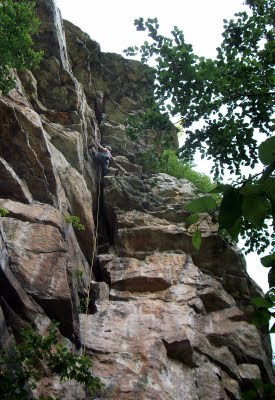
(Photo: Maryana almost through with pitch one of Pink Laurel (5.9))
When it was my turn to follow, I saw why people gripe about Pink Laurel. The polished part of the route is short, but it is the crux. Dick tells you to undercling left out of the alcove, but this advice only tells part of the story and doesn't begin to capture the weirdness of the move. It is a committing undercling up left with very slippery feet, then a step right, awkwardly straddling a corner. Another strenuous step up and you're out of the crux.
I didn't think the moves were hard, exactly, but they were strange and insecure. Very good protection is available but as I realized watching Maryana some care should be taken to protect the crux well.
I thought the climbing above the crux was interesting and unique. The remaining alcoves went at around 5.6, and there were some funky moves required to get out of them. Before I knew it I was at the ledge with Maryana.
Pitch one of Pink Laurel was very interesting, and a little different from your typical Gunks climb. I'd like to go back soon and lead it myself.
And I'd really like to go back and lead pitch two again because I totally botched it with Maryana.

(Photo: Vass leading pitch two of Pink Laurel (5.6 variation))
Last fall I did the 5.6 variation to pitch two of Pink Laurel with Vass, sending him up on lead after I led pitch one of Jackie. This easier variation of Pink Laurel is fun (I thought it seemed pretty soft for 5.6), and it led me to believe the 5.9 version of the pitch wouldn't be too difficult, because the crux would have to be short. Both versions of the pitch, easy and hard, start and end the same way. The only difference is that the 5.6 version cuts left around the roof while the 5.9 version cuts right.
Returning to the pitch with Maryana, I set off, getting to the stance atop the prominent pointed flake (just over Vass' head in the photo above) with ease. Then I headed right, towards what I thought was the 5.9 finish. An overhanging 5.7-ish traverse around a little nose led me a stance at a shallow left-facing corner. Here I looked up and could see a big angle piton in the roof above and to my left. I thought that this piton must be at the exit to Pink Laurel, but I wasn't sure I was supposed to go that far back left to exit the roof. It seemed especially contrived to go back and left when I was already standing at an easy-looking corner that seemed to go straight to the top.
So I went straight up the corner instead of heading back up and left, and since the climbing to the top couldn't have involved any moves harder than 5.5, I knew I'd messed up.
Later I looked at the photos in the guidebook and realized I'd traversed too far to the right, going all the way to the finish of A-Gape. This climb is a 5.11 down low but the part I did is easy and from all appearances seldom climbed. Judging from the line in the book I went straight right when I should have gone diagonally up and right from the stance at the flake. I don't know how I missed the line so completely.
Now that I've avoided Pink Laurel's second pitch from both sides, I have to go back and attack it directly!
Pink Laurel is a two-star classic you don't often see people doing. It looks intimidating. It sits just to the right of some very popular, easier climbs like Jackie (5.5) and Classic (5.7). The first pitch ascends a corner system, with the crux coming low at an escape from an awkward alcove. When we arrived at the base and looked upward, it seemed to me like the dark, awkward alcoves continued throughout the whole pitch.

(Photo: Maryana pondering the crux alcove on pitch one of Pink Laurel (5.9))
Maryana was more than up to the task of climbing the pitch. Although there were placement opportunities, she didn't put in any gear until she got herself through the easy starting territory and into the crux alcove. Once there she placed two solid cams. At the time I was ignorant of what was to come, so I didn't know to tell her what I'm going to tell you now: I'm not sure those two cams were placed optimally. If she'd blown the crux move they would have kept her from hitting the ground, but maybe not the rock at the base of the alcove. Maryana placed the cams in the ceiling of the alcove, one in the crack on the left and one in the crack on the right. Because the cams were set back a bit from the lip, she extended the draws on both of these pieces. Better, I think, would have been to place a cam right at the lip of the roof of the alcove, clipping it direct. No extension.
But she was totally solid on the moves, so there were no worries. As soon as she stepped up out of the alcove, I suggested she place a piece ASAP, which she did from a rather strenuous stance. Then it appeared the climbing eased for the rest of the pitch.

(Photo: Maryana almost through with pitch one of Pink Laurel (5.9))
When it was my turn to follow, I saw why people gripe about Pink Laurel. The polished part of the route is short, but it is the crux. Dick tells you to undercling left out of the alcove, but this advice only tells part of the story and doesn't begin to capture the weirdness of the move. It is a committing undercling up left with very slippery feet, then a step right, awkwardly straddling a corner. Another strenuous step up and you're out of the crux.
I didn't think the moves were hard, exactly, but they were strange and insecure. Very good protection is available but as I realized watching Maryana some care should be taken to protect the crux well.
I thought the climbing above the crux was interesting and unique. The remaining alcoves went at around 5.6, and there were some funky moves required to get out of them. Before I knew it I was at the ledge with Maryana.
Pitch one of Pink Laurel was very interesting, and a little different from your typical Gunks climb. I'd like to go back soon and lead it myself.
And I'd really like to go back and lead pitch two again because I totally botched it with Maryana.

(Photo: Vass leading pitch two of Pink Laurel (5.6 variation))
Last fall I did the 5.6 variation to pitch two of Pink Laurel with Vass, sending him up on lead after I led pitch one of Jackie. This easier variation of Pink Laurel is fun (I thought it seemed pretty soft for 5.6), and it led me to believe the 5.9 version of the pitch wouldn't be too difficult, because the crux would have to be short. Both versions of the pitch, easy and hard, start and end the same way. The only difference is that the 5.6 version cuts left around the roof while the 5.9 version cuts right.
Returning to the pitch with Maryana, I set off, getting to the stance atop the prominent pointed flake (just over Vass' head in the photo above) with ease. Then I headed right, towards what I thought was the 5.9 finish. An overhanging 5.7-ish traverse around a little nose led me a stance at a shallow left-facing corner. Here I looked up and could see a big angle piton in the roof above and to my left. I thought that this piton must be at the exit to Pink Laurel, but I wasn't sure I was supposed to go that far back left to exit the roof. It seemed especially contrived to go back and left when I was already standing at an easy-looking corner that seemed to go straight to the top.
So I went straight up the corner instead of heading back up and left, and since the climbing to the top couldn't have involved any moves harder than 5.5, I knew I'd messed up.
Later I looked at the photos in the guidebook and realized I'd traversed too far to the right, going all the way to the finish of A-Gape. This climb is a 5.11 down low but the part I did is easy and from all appearances seldom climbed. Judging from the line in the book I went straight right when I should have gone diagonally up and right from the stance at the flake. I don't know how I missed the line so completely.
Now that I've avoided Pink Laurel's second pitch from both sides, I have to go back and attack it directly!
Saturday, June 25, 2011
Gunks Routes: Sixish (5.4+)

(Photo: following the 5.3 pitch two of Sixish)
Sixish was one of my first outdoor climbing experiences. It may well have been THE first experience I had in the Gunks.
It was the summer of 2006. I was with my friend Greg, who'd introduced me to climbing in April of the same year. Greg had been climbing for a couple years. He had some leading under his belt, but not much.
I was little more than a liability to him. My experience was limited to toproping indoors with a GriGri. When we climbed outdoors, Greg had to teach me the standard commands and tutor me in ATC usage at the start of every pitch. I was just along for the ride, willing to follow Greg up anything. I was enthusiastic, but I brought nothing to the team. By agreeing to climb with me, Greg knew he was taking responsibility for both of us.
I remember nothing about the first two pitches. As I recall they went uneventfully enough.
What has stayed with me is what happened at the end of pitch two. We arrived at the GT Ledge and Greg began to scope out the 5.4 pitch three. And he wasn't at all pleased, because it looked scary. Over our heads was a gigantic roof. The guidebook said to move left to where the roof met the wall, and to climb up on the outside face of the cliff. Then we were to traverse back right just above the lip of the giant roof, and underneath a second roof, for about 15 feet to a notch, where we would head straight up to the top.
Greg thought the traverse looked precarious. It didn't appear to him that it could possibly be only 5.4. He worried that if he fell he'd hang below the roof and have trouble getting back on the rock. He was especially upset about a pointy dead tree stump, about ten feet tall, that stood on the GT Ledge just below the finishing notch. Greg envisioned taking a fall at the end of the traverse and being impaled on this stump. This was an unlikely event, but Greg can be morbid like that.
Of course, at the time, I had no tools with which to judge the likelihood of any of Greg's fears coming to pass. I just sat there impotently as he thought out loud about the risks of continuing, and about bailing. He considered leaving gear behind so we could rappel off. He worried about whether we could get down to the station atop pitch one with a single rope rappel. Unsure of this, he decided we had no choice but to continue.
Of course, I now know that we could have easily reached the next station with a single rappel. And I now know that we could have done even better: a short walk left on the GT Ledge would have taken us to the bolts above Kama Sutra, an unbelievably easy two raps to the ground. No need to leave any gear behind. But back then I was a blank slate, with nothing to offer, which turned out to be a good thing in this instance because our collective lack of information led us to continue with the climb.
Finally Greg led pitch three of Sixish; he got through it with no problems. Then I followed the pitch and it turned out to be a formative experience in my climbing life. I had no expectations, but the pitch nevertheless surprised and delighted me. No pitch in a gym was ever like this. The climbing up the face was straightforward, and then a perfect foot rail appeared just where you needed it to move back to the right above the giant roof. Traversing felt entirely different than moving upward; the most elementary of steps seemed somehow insecure when the movement was sideways. The position between the two roofs added a thrilling element of exposure. Then the exit through the notch to the top featured good holds, but the features of the real rock again seemed entirely new to me. Maneuvering my body through the notch was unlike any climbing I'd done before.
I arrived atop the cliff to find Greg totally high on having successfully done it. The lesson for him was that Dick Williams can be trusted. If Dick says the pitch is 5.4, you should have faith the holds will be there.
For me, the lessons were different. I was learning what real climbing was like. I was at a stage where I still found pulling on plastic to be novel, great fun. But doing a climb like Sixish made me see that climbing outside had so much more to offer. And I began to fall in love with the special features of the Gunks: the wandering traverses, the roofs, the escapes. The peace of sitting on the GT Ledge, comfortably belaying your partner in an atmosphere of seeming isolation among giant rocky overhangs. The pleasure of watching the birds slowly circle, of admiring the green valley below.
Fast-forward five years to 2011. I was climbing with Margaret on a very hot day. She was looking for easy leads, and after I led Son of Easy O (5.8) in the bright sunshine, I was looking to collapse, I was so dehydrated. We took the very short walk over to Sixish, and upon finding out it was in the shade, we decided to do it.

(Photo: Placing gear at the crux of the 5.4+ pitch one of Sixish)
I was figuring I'd lead pitch one because Margaret seemed interested in taking the easiest pitches. In the case of Sixish, the easiest pitch is the middle one, which is only 5.3. I also thought it might be fun to try the 5.6 variation start to the climb. But then we looked at the traditional 5.4+ start to the climb, which ascends a large left-facing flake and then moves left into the big corner system, and it seemed pretty straightforward. Margaret said she thought she'd be fine leading it. I was sure she'd be more than fine leading it and I was thrilled to follow her.
It turned out to be a bit of a sandbag. If I'd been told this pitch was rated 5.6 I wouldn't have argued. The climbing past the initial crux flake is steep and pumpy. The holds are very good, but hanging out to deal with pro is surprisingly strenuous. Then the pitch moves left to the big corner and it gets pretty pumpy all over again. This pitch is not very long, maybe 60 feet or so, but it packs a lot of value in.
Margaret had no trouble with the climbing, of course, but she did get a bit confused about where to belay. I told her I thought I remembered that she was to go all the way around the big corner to the left and onto the main face to finish the pitch. But she found a small ledge in the big corner which seemed to match the "small belay stance" mentioned in Dick's guidebook, so she stopped there. When I arrived I thought she'd made the right choice, but then I began to lead pitch two and as soon as I moved onto the main face I reached a much better stance with some fixed gear. This was obviously the right place to do it. It wasn't an issue of safety or even really of convenience, and Margaret didn't miss any important high-quality climbing by stopping where she did. But you'll find if you lead pitch one of Sixish that you'll have a more comfy belay if you move all the way around the corner onto the main face.
I led the 5.3 pitch two, and it was such a pleasure. The pitch goes up and slightly left, passing an overhang. Then it moves right to a vertical crack system that provides plentiful holds all the way to the GT Ledge. As I led the pitch I was struck by how nice the climbing was, and how I hadn't realized what I was missing by not doing these easy classics much any more. I couldn't remember the last time I considered doing a 5.4 like Sixish. There are so many of them in the Gunks; it is so easy to take them for granted. How many climbing areas have such high-quality super-moderates like this? In most places a 5.4 would be an unpleasant thrash up a gully. But in the Gunks you get clean climbing up steep rock with great holds and pro. What more can you ask for?

(Photo: At the end of the traverse on the 5.4 pitch three of Sixish)
When we reached the GT Ledge I found the scene unchanged from 2006. The big, pointy, dead tree stump was still there. I assured Margaret she'd find the perfect foot rail up there above the roof, and she cast off on the lead. While she took care of the lead I looked at the 5.10 b/c variation, which is the original aid route directly out the huge roof. Standing on the ledge it appeared to me there'd be good pro in the crack running out the roof but later I saw Dick gives this variation a PG/R rating. I'm not sure whether he gives it this rating because of the pro through the roof, or because of poor protection for the face climbing below. It looked like it would be fun to try it out if the pro were good. I'd wager it would be easy to rig a toprope from above by climbing Sixish through the traverse and then bulding a gear anchor above the roof, but I would be a little concerned about the swing you'd take if you blew it before making much progress out the roof, or during the face climbing below the roof. You might swing out and hit a tree pretty hard.
Soon enough it was my turn to follow pitch three. The traverse was great, still exciting and exposed even after a little more experience. I was surprised by one aspect of the pitch I didn't remember: the notch at the finish is kind of hard for 5.4! Like pitch one, it is surprisingly pumpy. The holds are there but they aren't quite the jugs I was expecting, and pulling through the notch felt to me a lot like pulling a small roof. It is a fitting finish to a great three pitches of climbing, well worth doing regardless of whether 5.4 is your leading limit.
Subscribe to:
Posts (Atom)