Showing posts with label Broken Sling. Show all posts

Thursday, November 12, 2015

Feeling Crass (5.10b) in Fat City (5.10d), & More!


(Photo: The Gunks in Autumn.)

I was very excited to get back to the Gunks after my trip to Indian Creek.

Don't get me wrong. The trip was nice, but I was out of my element there, struggling on the vertical cracks. I was eager to return to my home turf, where I was comfortable on my feet and where things have been going so very well lately.

I felt like I'd been away from the Gunks for a long time, even though it had only been a few weeks.

The high season was passing me by! Or not really. But I felt the itch. You climbing psychos know what I mean.

The year would soon end. I needed to hit something big with every day at the cliff. Who knew when a given climbing day would turn out to be the last one of the year?

I made plans with Adam to go to the Nears. I had one route in my sights:

Fat City Direct (5.10d).

This was a biggie, for sure.

It had been on "the list" all year. It was a must-do for 2015 as far as I was concerned. And we didn't have too much of 2015 left to play around with. I needed to get on it, and soon.

So Adam and I drove up on a Sunday morning, ready to hit it.

And then, as we careened down the road towards our destiny... it began raining.

This hadn't been in the forecast.

As we bravely carried on, it kept on coming down. We persevered in the face of the storm, only to arrive at the West Trapps lot in the midst of a misty sprinkle. It was cold too. Our little pocket computers promised us that the rain would pass over soon, so we optimistically went ahead and gathered up our crap, hiking over to the closest part of the Near Trapps, where the routes tend to stay dry under huge roofs.

Standing at the cliff we were sheltered from the falling rain but our spirits were nevertheless slightly dampened. The rock felt cold to the touch. We took our time getting started.

We thought about warming up on Outer Space (5.8) or Le PliƩ (5.7), but after we looked around a bit my eye fell on a roof problem about fifteen feet off the ground. I had never noticed this line before.

Taking my phone out of my pocket, I checked the Nears App and found out that this was Crass (5.10b), a short climb which goes over the crux roof just off the ground and then does a traverse around a corner to join Le PliƩ. The roof appeared to be well-protected. It looked fun. Why not give it a try?


(Photo: Adam on Crass (5.10b).)

I liked Crass. There isn't any gear for the first move up onto the easy slab but there is dynamite protection as soon as it gets difficult. The roof itself is tricky. I had to take a hang to figure it out. Once I sussed out the move it wasn't so hard. Above the crux overhang you reach another roof where there is good gear for the exciting traverse out and around the corner. This part is probably 5.8. And then it's over.

Crass is no classic but it provided good fun while we waited out the rain.

By the time we were finished things were looking up. The rain had passed and the cliff didn't seem too wet. There were a few other intrepid souls around but Adam and I had our pick of lines to do.

Adam had expressed an interest in Grand Central (5.9), so we did it. I led up the easy 5.6 part and built a belay so that Adam could take it the rest of the way to the top in one pitch covering both of the route's cruxes.

Grand Central is a good 5.9 and while it isn't the hardest nine out there-- the crux climbing is just a couple of steep moves on small holds-- it tests the budding 5.9 leader because the gear is small/fiddly and you have to commit to moving above your protection through the crux moves. Adam did well, hanging in to make sure he was happy with his placements and then climbing on through. And he made quick work of the upper crux, a reachy overhang which for me always requires a little lunge off of greasy feet.


(Photo: A blanket of fall colors, seen from the top of the Near Trapps.)

After we rapped off of the Alphonse tree (with my 70 meter rope; be careful folks!), it was decision time.

Was I ready to attack Fat City Direct?

In what is becoming a tradition for us, Adam suggested we go over and "just have a look at it."

This has come to mean that we are definitely going to do whatever climb we are "looking" at.

Fat City Direct ascends a most impressive portion of the cliff, winding steeply through a kaleidoscopic series of orange roofs. Like Erect Direction (5.10c), another legendary climb which I did last month, Fat City has hard crux climbing that no one talks about, which is then followed by slightly easier but more spectacular climbing that gets all the attention.

After walking over, I tried to scope out the hardest bits. I figured the initial 5.9 roof wouldn't be too bad. I tried to spot the 5.10d crux just above but I couldn't really tell where it was. I could see a bulging section above a notch and guessed that this had to be it. Then, looking higher, it was pretty easy to find the intimidating upper crux, where a sloping diagonal rail led to the lip of a big overhang. You can't see it from the ground, but I knew that an ancient, hard-to-clip piton was sitting at the lip of this roof, providing the only pro for getting over it. Dick Williams says that this part of the climb is 5.10b R.

I racked up, taking as many slings as I could dig out of my bag. This climb is often done in one super-long pitch. There is the option to stop and belay between the cruxes but I hoped to take it all the way to the top if I still had any gear left.


(Photo: Here I'm just getting started on Fat City Direct (5.10d), heading for the 5.9 roof. Photo by Adam.)

Getting started, I felt a little bit shaky at the initial 5.9 roof. There was a lot of chalk all over the place and I initially went at it the wrong way. But eventually I changed tactics and it went fine.

Pretty soon after that I came to a shallow overhang. There were some fixed nuts. I thought this must be it: the 5.10d business. I experimented with working out the move, going this way and that. Placing more gear. Eventually I did a committing layback up over the little roof. It was a success. Thinking I'd just done the hard bit, I was feeling good.

But then I quickly found myself in a little notch under yet another overhang, with tiny crimps leading to the left.

Oops, my bad. This was obviously the real crux.

I took a long time there, checking my gear (small Aliens), testing the crimps. Every time I tried to commit to going left I felt like I didn't have it and I came back. Luckily there was a stance there, where I could chicken-wing my arm in the notch and reset.

Finally on my umpteenth foray I worked out a way to get my feet higher, and I found myself committed. My right hand was on a bad crimp; my left was on a sloping vertical feature. Standing up and reaching higher, I prayed the horizontal I was reaching for would offer a little more security.

Eureka! It was a jug. With a "woo hoo!" and an "oh yeah!" I was out of the woods.


(Photo: Emerging from the 5.10d crux on Fat City Direct. Photo by Adam.)

The bolted belay station was a short distance above me and to the left but I thought I had just enough slings to keep going, so I scampered straight up to the final challenge, the famous Fat City upper roof.

I vowed to keep calm and to try to execute. I didn't want a repeat of my Erect Direction experience, where I on-sighted the hardest parts and then blew it when I got nervous in easier territory.

Also I needed to get on with it. This lead was taking forever.


(Photo: At the upper crux roof on Fat City Direct. Photo by Adam.)

It went really well. There is a fixed pin right before the difficulties. I backed this up with two cams. Then it was go time. I breathed deeply and willed myself into "the zone." I only needed to test the holds once or twice before I moved out to the overhang. I had no trouble clipping the well-known sketchy piton at the lip (which I cannot believe was placed on the lead by Gary Brown in 1968!). Then I moved up and over the roof without hesitation, knowing somehow, without a doubt, that this move was going to be fine. Standing above the roof, I put in a piece to protect the second and exhaled, secure in the knowledge that Fat City was finally in the bag.

The 5.8 climbing which followed, winding through several more overhangs, went by in a blur.

I couldn't wait for Adam to join me up top so I could thank him for patiently belaying me on the greatest on-sight of my life.

Fat City Direct is a wonderful climb, with many awesome moments. It is definitely worthy of its legendary status. Done in a single lead it is a monster pitch, nearly 200 feet long. I was psyched to do it that way but I felt compelled to run it out in between the hard parts, both to avoid drag and to conserve gear. At one point Adam was begging me to place a piece. Don't be too alarmed-- he didn't know how easy the climbing was in that section. Nevertheless, I think if I go back I will probably break it up by stopping at the bolted anchor. It is a natural stopping point and it's surely safer to do it that way.

Regarding the exposed upper crux, I think it might be easier than 5.10b. Maybe it's 5.10 minus? And I'm not sure why Dick gives it an R rating. It seems to me that it isn't R if the pin at the lip is good. On the other hand, if the pin is not good it is certainly R; blowing the roof and pulling the pin would be bad news. And who can say whether that pin is at all trustworthy? It has been there a long long time.


(Photo: Adam getting ready to rap off at the Alphonse tree.)

We still had time for more climbing. Adam wanted to lead Broken Sling (5.8) and I wanted to do whatever Adam wanted to do. After Fat City I was cool with anything.

I had only been on Broken Sling once, in 2013. I really liked it then but I thought the first pitch was awkward and in your face, and that the second pitch was hard to protect well.

Adam did a super job leading both pitches.


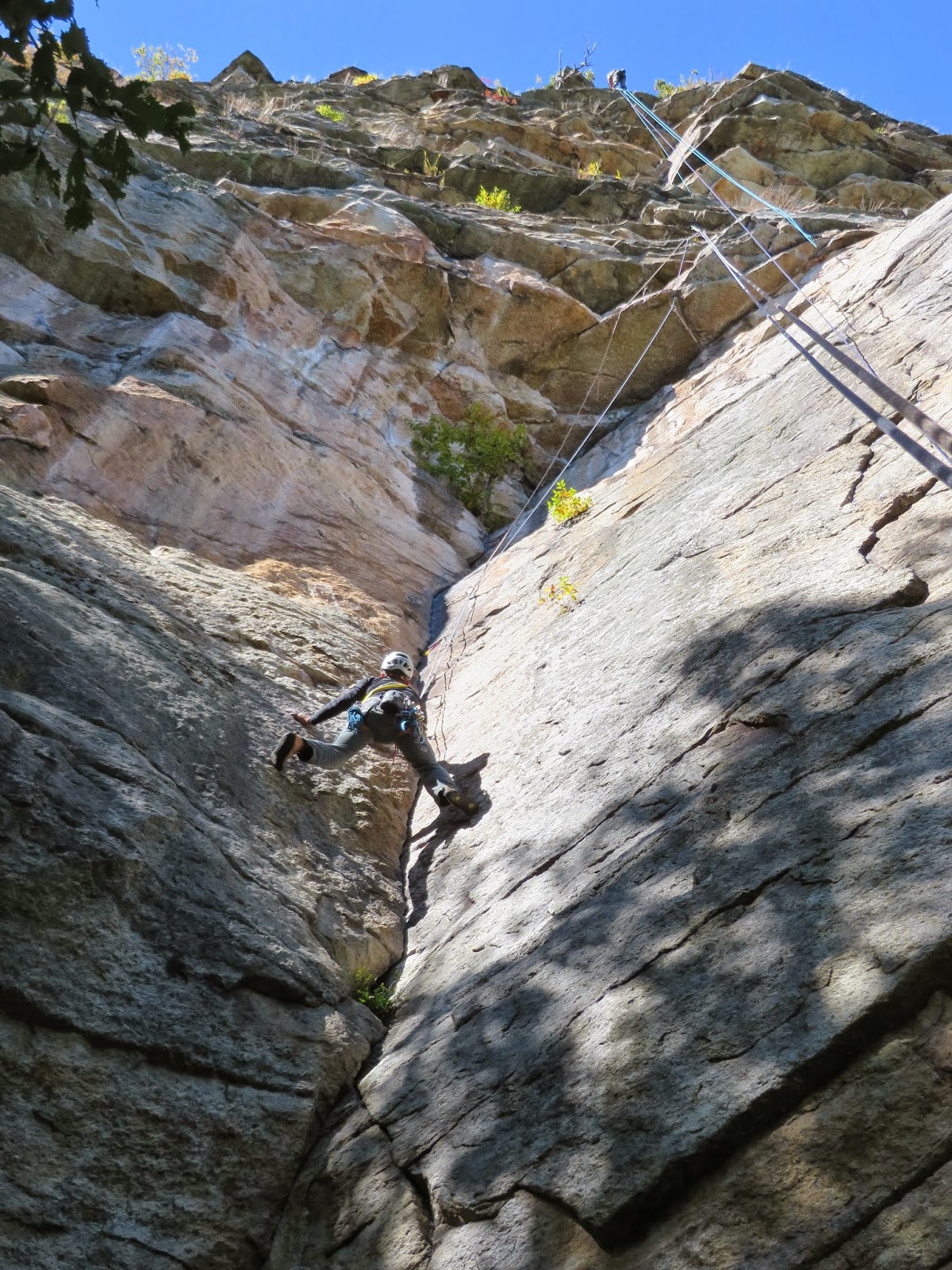
(Photo: Adam over the first hard moves on Broken Sling (5.8).)

My opinion of Broken Sling remains basically the same. It is sometimes awkward, and at times a bit necky. But wow, this route is really great. So varied and challenging, with tons of climbing packed into two short pitches. It is a worthy classic, and a proud lead.

With the sun going down, I decided to run up Disneyland (5.6-) for a fun, easy end to our day. Apparently I've never written about this very popular climb, but it is a favorite of mine, and just another example of how deep the 5.6 grade is in the Gunks.

Sitting atop the cliff, gazing at the leaves, I started to think about the next big target. What would it be? Would there be any more highlights I could squeeze out of 2015?

Who knows?

Sunday, September 29, 2013

Gunks Routes: Broken Sling (5.8) & Bird Cage (5.10b)

September 25 was one of those incredible autumn days in the Gunks. We enjoyed perfect temperatures, fresh air, grippy rock... Who could ask for anything more?

I was climbing with a new partner named Michael. I met him on the Internet. He was looking for someone to climb with on a Tuesday and I had the opportunity to take a day off so I jumped in. We had a really nice day together in the Near Trapps, doing what for me were some new routes and some old favorites. Michael let me do most of the leading, which is always a bonus (though of course I'm also happy to follow sometimes)!

We warmed up on an old favorite: Te Dum. I elected to do the direct variation, which goes straight up a corner to the nice face with a crack, rather than starting several feet to the left and traversing to the crack later. I enjoyed this (5.6) direct start and then after rejoining the regular route the face with the crack surprised me, as it always does. I always forget about this good face climbing which comes before the crux move around the tree. And after the crux the easy climbing up a slab to the finish is a pleasure. Te Dum is a very nice route. Definitely do it in one pitch.

Once we walked back around I proposed we do a climb I've been thinking about for years but have never quite gotten up the nerve to do: Broken Sling (5.8).

This climb is known as a test piece at its grade. The bouldery opening move has always frightened me. It looks like an ankle-breaker. I've also heard that the second pitch has a traverse that is hard to protect. Despite these real concerns I've been wanting to do it. I've been pretty confident the climbing would go fine, and it is a three-star climb, after all. You can't pass up a three star 5.8 forever.

Michael was fine with it so I was in business.


(Photo: The bouldery, polished start to Broken Sling (5.8). Look for the footholds-- they do exist!)

I think the first pitch is great. It just keeps coming at you with challenging moves. I felt it was hard for 5.8, but well-protected. The leader has to make just one or two moves off the ground before he or she can grab the initial shelf and place a bomber yellow Camalot to the left. It is a little strenuous to place the cam but you really should do it because the next move, which gets you to a standing position under the roof, is no gimme. After these initial moves the crux is over but the roof which comes next is a good 5.8 challenge... as is the climbing up a crack to the right which follows, and the final moves up onto the slab on which you build a belay. It is all challenging. I kept waiting for the pitch to ease off but it just keeps on going all the way to the belay stance.

I reckon the second is at greater risk of injury in a fall than the leader on the opening moves, since even with a top rope the second might crater with just a little slack or rope stretch. I tried to keep it very tight on Michael as he began the pitch, but he was fine on the moves so we had no worries.


(Photo: Michael working out the final awkward move to the belay ledge on pitch one of Broken Sling.)

While pitch one of Broken Sling is a sandbag, pitch two is just kinda scary.

The climbing is nice and completely different from pitch one. You make a delicate traverse right for 15-20 feet, then more thin moves take you up to a ceiling, where you traverse back left to a great roof problem which finishes the pitch.

The pro is the issue. The initial traverse provides little reliable gear. I actually got three pieces in but I didn't have 100 percent faith in any of them. Maybe my blue Alien was good. Maybe my sideways-placed small nut was solid but I did not want to test these pieces. The pink Tricam in a flaring pocket? Fuhgeddaboudit. My anxiety increased as I moved up to the ceiling, because there is no pro at all-- good or bad-- for these interesting moves after the traverse.

Once you reach the ceiling there's bomber gear and then two steps left take you to the notch, where there is gear galore. A few burly moves through the overhang and you're done.

I really enjoyed Broken Sling and I'd probably do it again. But it is not a climb for the new 5.8 leader. You want to feel really solid in the grade. It is necky.

After we were done with Broken Sling Michael said he was interested in leading Birdland so we went over there next. This is one of the most popular climbs in the Gunks, and it is regularly used to set up the harder climbs around the corner, so even on a Tuesday I expected we might find people there.

Sure enough there was a party of three on the route. They seemed to be moving quickly so I thought maybe while we waited I'd lead the next-door Farewell to Arms (5.8), another test piece at the grade. I have followed it once but never led it. The pin that protects the low traverse recently fell out, and I wondered, as I looked it over, whether there are placements to compensate for the missing pin.

But then my attention turned to the other climb that starts in the same location: Bird Cage (5.10b).

This climb follows a beautiful natural line, going up the crack at the back of the open book to the left of Birdland. Then a thin traverse out right (some call this the crux) under a huge ceiling takes you to a notch where you surmount the gigantic overhang (the other crux).

Bird Cage was one of the 5.10's on my list. It looked so appealing, irresistible even. I had to get on it.


(Photo: Michael working up the 5.9 corner on Bird Cage (5.10b).)

I thought the initial 5.9 corner was amazing. It is technical, continuous and challenging, but there is always gear nearby and if you have patience the moves present themselves. About halfway up I stopped at a mini-stance, thinking I was through the hard moves, and reflected upon how much I was enjoying myself. Then the business resumed again and it got a bit harder still. Thankfully the corner eases off before you reach the overhang so you can cozy up to the top of the corner, scope out the traverse and get plenty of rest before embarking on the crux of the route.

I got two good cams at the top of the corner and surveyed what was to come. There is a junky old pin a few feet out on the traverse and then a pair of fixed wires at the back of the roof right where you pull over it. The nuts looked good to me. It appeared I had two options for the traverse out to the notch in the roof. I could use some tiny crimps up high, or instead some tiny undercling holds a little lower. It seemed like you'd have to get your feet up pretty high to use the underclings. I couldn't tell how it was going to work out until I committed. But after clipping the pin I checked out the high crimps, and I did not care for them, not one bit.

So I stepped down, swallowed deeply and committed to the underclings. I tried to place my toes very carefully, put my weight on the left-hand jug, reach over and shift to the undercling. And it worked. Just a step or two went by and I found myself at the mid-point of the roof, under the cleft, at some small but positive crimps and some good little edges for my toes. I carefully clipped both of the nuts, took another breath and reached out to the cleft at the lip of the roof...

And it was on, baby! What a great roof. I don't want to give it away but this is a fantastic sequence. Your body needs to be facing in one direction to get started and then the other to finish. There are bomber holds.

I fired through it and I had my second Gunks 5.10b onsight of September! It was so satisfying. Crouching at the cramped stance above the roof, I placed a cam and felt like a million bucks. Just a month ago I was out of practice and wondering if I would get anywhere at all with my 5.10 list during the remainder of 2013, but here I was now, seemingly in pretty good form on Bird Cage. Sending season had really started to come through for me.


(Photo: Michael eying the traverse on Bird Cage.)

After I came down to belay Michael I was talking to some folks at the base who suggested that there is an easier way to get to the roof, by moving out onto the face about ten feet below the overhang and heading to the right, following a seam to the roof.

Michael struggled a bit with Bird Cage and eventually gave up on the difficult traverse, and when I went up to clean the gear I got to try this face variation. I do think it is easier, and the moves up at the seam are thin and interesting. I wish I'd thought to check out the gear but I didn't. Anyway, although this variation is good I don't think it gives you the full challenge of the real Bird Cage. Being right up against that roof and figuring out the traverse is a key part of the whole experience of the climb, I think.

We ended our day by doing both pitches of Birdland (5.8). This route is always such a pleasure, especially the fun, continuous face climbing on pitch one.


(Photo: Michael leading past the first tough bit on Birdland (5.8+).)

Michael was rolling along on the first pitch, but hesitated at the crux move. He was fiddling with his gear when a stranger walked up the path and stopped to watch. The man stood there as Michael and I discussed the gear. I turned around to look when the stranger said "you want a yellow Alien there for the crux."

It was Dick Williams! I recognized the guidebook author/Gunks climber extraordinaire immediately. I'd seen him before but never had the opportunity to say hello. I confess I was a star-struck nerd. I told him it was an honor to meet him and talked to him about Bird Cage. He stayed another minute then moved along. I was grateful he left, for Michael's sake. The last thing I'd need if I were nervous at the crux and fiddling with gear is to have Dick Williams watching me.

I led pitch two of Birdland and I think I may have just been tired, but I enjoyed it less than I have in the past. The moves right off the belay felt dicey to me, and every time I wanted to place gear I found junky rock all over the place. The crux move up into the hanging corner near the top is great, though, and I opted for the 5.8 finish to the right, which I now think is much nicer than the direct 5.9 roof finish. The moves to the right and over the top are fun.


(Photo: Topping out on Birdland.)

This was a stellar day for me. I felt as though suddenly things have come together a little bit. The favorable temperatures have undoubtedly played a part. I think the other key element has been patience. On Bird Cage, and a few weeks ago on Feast of Fools, I tried to milk rests, think ahead, and really focus on my technique. Rather than just climbing I've tried to be very conscious of my decision-making process and not stumble into mistakes. Maybe this new mental fortitude has played a role in my success?

Or maybe it's just that I ditched the gear sling after my fiasco on Stannard's Roof.