A week's vacation in the New Paltz area is, to me, like a dream come true. My wife is very generous to agree to it year after year. Not that it's such a huge sacrifice for her. She likes the town and the beautiful countryside. There are great hikes for the whole family. And the community pool is nice.
But if the cliffs weren't there it obviously wouldn't be our first choice for a vacation destination. My wife goes there for me, because she knows how much I love climbing there. In a week in New Paltz I'll climb two of the days, maybe part of a third; more than that would be too much time away from the family. And the whole rest of the time we're there I'll just be staring at the cliffs, wondering how anyone can live in such proximity to them and NOT be a climber.
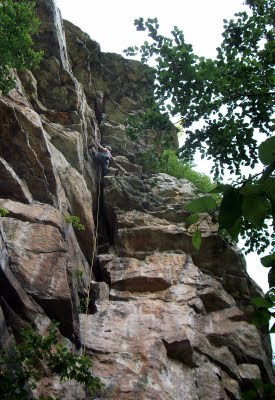
This year as our week approached I was in the unusual position of not having any partners firmly lined up. Gail suggested a new partner to me named Parker. A young guy, Parker's been climbing a couple years, and he's been working on the 5.9's like me, even trying a couple 5.10's. Gail is a good matchmaker; we had a great day together.
We met up on a sunny Thursday. It was expected to be quite hot so we mostly stuck to first pitches, which at least gave us some shade at the base of the wall.
On the way to the cliff we talked a bit about our objectives. Our goal: do some 5.9's! We settled on the Mac Wall as our first destination of the day. Parker was interested in leading MF (5.9). It is known as a real testpiece at the grade, with a pin at the first crux and then a bit of a runout through the second crux. I have never done MF and I am still too scared to lead it, so I was kind of excited to follow it and see what the fuss is all about. We were thinking that after MF I would lead Higher Stannard (5.9-), which is just a few climbs to the left.
As it turned out, MF was wet. So I had no choice but to jump on Higher Stannard right away. Warming up is overrated, I've decided.
Higher Stannard is a face climb, and the line isn't obvious from the ground. Dick does his best in his guidebook to to help you find the route; various thin cracks and right-facing, ramp-like corners are mentioned. The problem is that there are many little cracks and right-facing ramp-like corners on the wall. It all looks the same. Last year I tried once to stand beneath the route and find the line; on that occasion I was about 95% sure I could see where to go. Then I tried to lead the route earlier this year, got up about three moves, and decided I had no idea if I was on-route or not. So I downclimbed and did Something Interesting (5.7+) instead.
This time I had Parker as my trump card. He'd done the route before. I also took a hard look from the ground and thought I spied the crux ramp-like corner beneath a thin crack. So then I started up, did the surprisingly difficult starting move with the smeary feet, and got it wrong again. I moved to the right, and then started to head up too soon, but Parker told me I was off. If you are as unfamiliar with the route as I was, my advice is that you make a note of the crux corner and crack from the ground. It is behind and just to the right of the big tree at the base of the wall. You start climbing well to the left of this tree, then move right. Continue going right, farther than you might think you should. Then look up for the corner and crack, using the tree as a reference.
There is a great horizontal for gear at the base of the crux corner. I put a bomber tricam in there, and then started to work out the move. It is thin, balancy... with the gear at your feet. I started to step up, then backed down and placed another piece next to the tricam. It was an application of the timeless climbing wisdom expressed by the father character in the opening scene of Vertical Limit: in climbing, best to have both a belt and suspenders.
Once I was satisfied with my two pieces of bomber pro, I made the move-- walking up the little ramp-like corner with sideways crimps for the fingers. Nice, and fairly graded, I think, at 5.9 minus. The rest of the pitch is outstanding, with many thoughtful moves in the 5.7 to 5.8 range. The gear comes along just when you need it. The final two overhangs are in the same range and very well protected.
After the initial route-finding challenge, it becomes easier to stay on the path, but you should still take care to look around. The usual Gunks chalk marks are very helpful.
Despite the wandering line, I think the first pitch of Higher Stannard is one of the best climbs I've done this year. Awesome moves from the start to the finish. With a short crux and good gear, it is a wonderful 5.9 on the easy side of the grade, although the climbing is sustained at just a slightly lower level of difficulty. High quality face climbing throughout, and then two little roofs as a bonus.
After Higher Stannard it was Parker's turn to lead and he decided to have a look at Beatle Brow Bulge, a 5.10a that used to be rated 5.9+. It has a huge crux roof and then juggy steepness after that for 30 or 40 feet to the end of the pitch. It was another climb I was psyched to check out. I've even considered that I might try to lead it one of these days. Unfortunately it was wet, so we had to change plans again. Parker decided to lead the nearby Friends and Lovers (5.9), which I'd followed once before. Climbing it again for the second time, I breezed through both cruxes but still doubted I'd be happy leading it, with the pro at your feet for the smeary second crux and at least one or two more moves before the next placement appears. It seemed committing in the extreme, and yet I'd just led a climb that was very similar. The gear was at my feet on Higher Stannard, and hadn't I made another move up before finding another placement? What was the difference? Was it the difficulty? Or was it just that every time you follow a hard climb you think "whew, I sure am glad I'm not leading this!" Then when you are on lead yourself, you just carry on and get through it.
Soon enough it was my turn to pick another climb, and I suggested we head down the cliff, past High E, to where the wall undulates in and out, creating more shady nooks for cooler belaying. Once we got down there I settled on The Nose/Fillipina link-up (5.9-). This was one of the few 5.9 minuses I had left to try.
Fillipina is another route people sometimes have trouble finding. But if you know what to look for you can locate the correct roof from the base. Looking upwards, try to find the roof with two thin parallel cracks running diagonally to the right from the wall to the lip. Several feet below these parallel cracks there is a fixed piton you can spot from the ground. This is where you're going.
I thought most of the pitch was just okay, but the roof problem gave full value.
When I started on the Nose's dihedral, I was surprised-- it seemed pretty stout for 5.6+. Fun moves go up the corner, with great pro in the crack at the back.
Then it becomes awkward. It is kind of awkward exiting the corner, then it is awkward again moving past the tree and stepping left and up to the slab beneath the roof. I didn't find this part of the climb so difficult, but my anxiety increased as I approached the overhang. It seemed more and more imposing as I approached it; my movements became slower and slower.
There is a good stance beneath the roof, and thank goodness, because I needed a place to retreat to. From the stance you have to get your hands to the good holds above the lip and then move right. I stepped up there and placed a bomber cam in the good horizontal. Then I stepped down again and took a rest. I went back up and took a good long look at the next move right, to a finger-sized horizontal where the footholds just drop away. Scary. I stepped down again.
It was time to commit. I went up again, threw in another cam (suspenders and a belt!) and then made the move right to the finger-sized horizontal. This was it, I wasn't going back now. Thankfully I could now see the way up through the notch, and two or three burly moves got me through it. It's all there, and the hands and feet improve with each move up. I don't know if I could have thrown in another piece mid-crux, but even if I could have there was no way in hell I was stopping to place one.
For me there's no feeling like pulling a roof. Getting over the roof on Fillipina was definitely one of those let-out-a-whoop and an "oh yeah!" kind of moments. I also recall shouting something (and here I'm paraphrasing to avoid using off-color language in this family-friendly blog) about the "minus" in the grade being kind of unreasonable.
The crux on Fillipina is harder, in my opinion, than anything on Wasp or The Spring, two other 5.9 climbs I've led recently. I thought it was harder than Apoplexy and Pink Laurel. I don't think I would give it a "minus."
It is a really good 5.9 roof problem, and committing for sure. I thought Friends and Lovers was committing? After doing Fillipina it seems like nothing.
Saturday, July 16, 2011


Wednesday, July 13, 2011
Gunks Routes: Pink Laurel (5.9)
It had been a wonderful weekday in the Gunks. After we finished up with The Seasons, Maryana was looking for a 5.9 to lead. She suggested Pink Laurel, mostly because the first pitch has a G rating. I'd never done the first pitch, but had long been curious about it. I told her my understanding was that the first pitch crux is short but polished/greasy and that some people hate the route. But I also told her I've been wanting to do it and that I'd love to lead the 5.9 pitch two. So off we went.
Pink Laurel is a two-star classic you don't often see people doing. It looks intimidating. It sits just to the right of some very popular, easier climbs like Jackie (5.5) and Classic (5.7). The first pitch ascends a corner system, with the crux coming low at an escape from an awkward alcove. When we arrived at the base and looked upward, it seemed to me like the dark, awkward alcoves continued throughout the whole pitch.

(Photo: Maryana pondering the crux alcove on pitch one of Pink Laurel (5.9))
Maryana was more than up to the task of climbing the pitch. Although there were placement opportunities, she didn't put in any gear until she got herself through the easy starting territory and into the crux alcove. Once there she placed two solid cams. At the time I was ignorant of what was to come, so I didn't know to tell her what I'm going to tell you now: I'm not sure those two cams were placed optimally. If she'd blown the crux move they would have kept her from hitting the ground, but maybe not the rock at the base of the alcove. Maryana placed the cams in the ceiling of the alcove, one in the crack on the left and one in the crack on the right. Because the cams were set back a bit from the lip, she extended the draws on both of these pieces. Better, I think, would have been to place a cam right at the lip of the roof of the alcove, clipping it direct. No extension.
But she was totally solid on the moves, so there were no worries. As soon as she stepped up out of the alcove, I suggested she place a piece ASAP, which she did from a rather strenuous stance. Then it appeared the climbing eased for the rest of the pitch.
(Photo: Maryana almost through with pitch one of Pink Laurel (5.9))
When it was my turn to follow, I saw why people gripe about Pink Laurel. The polished part of the route is short, but it is the crux. Dick tells you to undercling left out of the alcove, but this advice only tells part of the story and doesn't begin to capture the weirdness of the move. It is a committing undercling up left with very slippery feet, then a step right, awkwardly straddling a corner. Another strenuous step up and you're out of the crux.
I didn't think the moves were hard, exactly, but they were strange and insecure. Very good protection is available but as I realized watching Maryana some care should be taken to protect the crux well.
I thought the climbing above the crux was interesting and unique. The remaining alcoves went at around 5.6, and there were some funky moves required to get out of them. Before I knew it I was at the ledge with Maryana.
Pitch one of Pink Laurel was very interesting, and a little different from your typical Gunks climb. I'd like to go back soon and lead it myself.
And I'd really like to go back and lead pitch two again because I totally botched it with Maryana.

(Photo: Vass leading pitch two of Pink Laurel (5.6 variation))
Last fall I did the 5.6 variation to pitch two of Pink Laurel with Vass, sending him up on lead after I led pitch one of Jackie. This easier variation of Pink Laurel is fun (I thought it seemed pretty soft for 5.6), and it led me to believe the 5.9 version of the pitch wouldn't be too difficult, because the crux would have to be short. Both versions of the pitch, easy and hard, start and end the same way. The only difference is that the 5.6 version cuts left around the roof while the 5.9 version cuts right.
Returning to the pitch with Maryana, I set off, getting to the stance atop the prominent pointed flake (just over Vass' head in the photo above) with ease. Then I headed right, towards what I thought was the 5.9 finish. An overhanging 5.7-ish traverse around a little nose led me a stance at a shallow left-facing corner. Here I looked up and could see a big angle piton in the roof above and to my left. I thought that this piton must be at the exit to Pink Laurel, but I wasn't sure I was supposed to go that far back left to exit the roof. It seemed especially contrived to go back and left when I was already standing at an easy-looking corner that seemed to go straight to the top.
So I went straight up the corner instead of heading back up and left, and since the climbing to the top couldn't have involved any moves harder than 5.5, I knew I'd messed up.
Later I looked at the photos in the guidebook and realized I'd traversed too far to the right, going all the way to the finish of A-Gape. This climb is a 5.11 down low but the part I did is easy and from all appearances seldom climbed. Judging from the line in the book I went straight right when I should have gone diagonally up and right from the stance at the flake. I don't know how I missed the line so completely.
Now that I've avoided Pink Laurel's second pitch from both sides, I have to go back and attack it directly!
Pink Laurel is a two-star classic you don't often see people doing. It looks intimidating. It sits just to the right of some very popular, easier climbs like Jackie (5.5) and Classic (5.7). The first pitch ascends a corner system, with the crux coming low at an escape from an awkward alcove. When we arrived at the base and looked upward, it seemed to me like the dark, awkward alcoves continued throughout the whole pitch.

(Photo: Maryana pondering the crux alcove on pitch one of Pink Laurel (5.9))
Maryana was more than up to the task of climbing the pitch. Although there were placement opportunities, she didn't put in any gear until she got herself through the easy starting territory and into the crux alcove. Once there she placed two solid cams. At the time I was ignorant of what was to come, so I didn't know to tell her what I'm going to tell you now: I'm not sure those two cams were placed optimally. If she'd blown the crux move they would have kept her from hitting the ground, but maybe not the rock at the base of the alcove. Maryana placed the cams in the ceiling of the alcove, one in the crack on the left and one in the crack on the right. Because the cams were set back a bit from the lip, she extended the draws on both of these pieces. Better, I think, would have been to place a cam right at the lip of the roof of the alcove, clipping it direct. No extension.
But she was totally solid on the moves, so there were no worries. As soon as she stepped up out of the alcove, I suggested she place a piece ASAP, which she did from a rather strenuous stance. Then it appeared the climbing eased for the rest of the pitch.

(Photo: Maryana almost through with pitch one of Pink Laurel (5.9))
When it was my turn to follow, I saw why people gripe about Pink Laurel. The polished part of the route is short, but it is the crux. Dick tells you to undercling left out of the alcove, but this advice only tells part of the story and doesn't begin to capture the weirdness of the move. It is a committing undercling up left with very slippery feet, then a step right, awkwardly straddling a corner. Another strenuous step up and you're out of the crux.
I didn't think the moves were hard, exactly, but they were strange and insecure. Very good protection is available but as I realized watching Maryana some care should be taken to protect the crux well.
I thought the climbing above the crux was interesting and unique. The remaining alcoves went at around 5.6, and there were some funky moves required to get out of them. Before I knew it I was at the ledge with Maryana.
Pitch one of Pink Laurel was very interesting, and a little different from your typical Gunks climb. I'd like to go back soon and lead it myself.
And I'd really like to go back and lead pitch two again because I totally botched it with Maryana.

(Photo: Vass leading pitch two of Pink Laurel (5.6 variation))
Last fall I did the 5.6 variation to pitch two of Pink Laurel with Vass, sending him up on lead after I led pitch one of Jackie. This easier variation of Pink Laurel is fun (I thought it seemed pretty soft for 5.6), and it led me to believe the 5.9 version of the pitch wouldn't be too difficult, because the crux would have to be short. Both versions of the pitch, easy and hard, start and end the same way. The only difference is that the 5.6 version cuts left around the roof while the 5.9 version cuts right.
Returning to the pitch with Maryana, I set off, getting to the stance atop the prominent pointed flake (just over Vass' head in the photo above) with ease. Then I headed right, towards what I thought was the 5.9 finish. An overhanging 5.7-ish traverse around a little nose led me a stance at a shallow left-facing corner. Here I looked up and could see a big angle piton in the roof above and to my left. I thought that this piton must be at the exit to Pink Laurel, but I wasn't sure I was supposed to go that far back left to exit the roof. It seemed especially contrived to go back and left when I was already standing at an easy-looking corner that seemed to go straight to the top.
So I went straight up the corner instead of heading back up and left, and since the climbing to the top couldn't have involved any moves harder than 5.5, I knew I'd messed up.
Later I looked at the photos in the guidebook and realized I'd traversed too far to the right, going all the way to the finish of A-Gape. This climb is a 5.11 down low but the part I did is easy and from all appearances seldom climbed. Judging from the line in the book I went straight right when I should have gone diagonally up and right from the stance at the flake. I don't know how I missed the line so completely.
Now that I've avoided Pink Laurel's second pitch from both sides, I have to go back and attack it directly!
Friday, July 8, 2011
Gunks Routes: The Seasons & More
I'm getting behind in my blogging. I've been climbing but I haven't been posting. A few quick climbing days in a row plus a week's vacation will do that to you.
Flashback to June 20. My friend Maryana and I took advantage of a break in the summer heat to get in a pleasant weekday's climbing.
We both had similar goals. I've been working back into the 5.9's, and Maryana is starting to lead them too. Or I guess I should say Maryana has just started leading 5.9, but she's rocketing through the grade and I have no doubt she'll leave 5.9 in the dust in short order. As recently as March she'd only led a couple trad pitches in her life. But her growth has been rapid and amazing to watch. She weighs next to nothing, she has great instincts, and she climbs all the time. She also has several partners who climb much harder stuff. All of this taken together means she'll soon be leading climbs that I have hardly any hope of following, much less leading myself.
But for now, in this one brief moment in early summer 2011, she and I can be plausibly considered equals.
On June 20 we had a really good day together. I warmed us up on V-3 (5.7). It was my first time on the route. It was pleasant but not as exciting as I expected. I thought I would be forced to use opposition and stemming to get up into the famous V-shaped notch that ends the pitch, but to my surprise I found good face holds inside the notch, pulled easily up into it, clipped the pin, and the climb was basically done. Nice, but nothing to rave about, in my opinion.
Then I suggested Maryana lead Absurdland (5.8; I believe Williams used to call it 5.9-). I led it two years ago, and I remembered it as having good crux thin face climbing, which is Maryana's specialty. I also remembered the crux as being short, so I thought it would be well within her abilities. I actually remembered the climb as being a little underwhelming, because after the low crux moves it eases off into mellow cruising on lower-angled jugs for the final two-thirds of the pitch.
Well, Maryana managed the low cruxes quite well, and placed great gear, sending the climb with style. As I followed the pitch I was impressed. The hard bit is a little longer than I remembered, with two or three steep crux moves in a row. The hands are good. The feet are thin and more of a challenge. The cruiser climbing above is very nice. I decided I've been underrating Absurdland. It is a beautiful pitch.
I next proposed we head down to The Seasons, for a couple reasons. The first was that I wanted to lead The Spring. I thought it fit my "easy" 5.9 criteria. The crux seemed like it would be short, at a little rooflet about 15 to 20 feet up, and it appeared the pro was good, with a vertical crack running up the whole pitch. I had seen reports that the early pro was a little tricky, but that the crux pro was solid. I was ready to give it a go.
The second reason I wanted to head down to the Seasons was that I hoped we could toprope the other, harder Season climbs, and that I would learn a thing or two from Maryana. One of the reasons she's improved so quickly is that she's been climbing with people who like to work these harder climbs. I wanted to see what she'd do with The Fall (5.11a) and The Summer (5.11d). And I wanted to see if I could do anything with them as well. I'm not much of a toproper but a few weeks before I'd been surprised at my success on Maria Redirect (5.11a), and I was curious to see if that success was just a fluke.

(Photo: Past the crux rooflet on pitch one of The Spring (5.9))
But before we could work on the 5.11's I had to lead the 5.9.
It went down pretty quickly. In my opinion the first pitch of The Spring is one of the easier 5.9's I've led this year. I got some disagreement on this point from other folks on Gunks.com, so you should keep in mind that I am fond of corner climbs like The Spring. Perhaps the climb actually plays to some unknown strength of mine, which makes it seem easier to me than it would to others? But in my experience, the moves up to the rooflet are straightforward, and then the move over the roof is strenuous but features great holds. One more steep move after that, again with very positive holds, and the real business of the pitch is over. What remains of the pitch is a somewhat awkward exit from the corner to the right and up, then the final easy moves to the bolted anchor.
The pro did prove to be surprisingly tricky. The crack at the back of the corner is the only place to put pro until you reach the rooflet, and it is a pretty thin seam. I worked in a nut a few moves up. I tested it for a downward and outward pull and I thought it would hold, but I also expected it to lift out as I got higher, and it did. Nevertheless I think this nut was acceptable for its purpose; if I'd fallen right after placing it I think it would have held me. I then worked a pretty marginal C3 into the crack just a couple feet above the nut. I wasn't sure what this cam was worth, but it was just another step to the rooflet, where I had dynamite pro in the horizontal to the left.
Above the rooflet, the crack at the back is again the thin seam, and if you feel like it you can hang in there and try to place a tiny nut. I didn't try. I took the extra step, and then got a bomber red C4 over my head where the crack widened. Looking at this pro afterward, I could see that if I'd blown the clip to the red C4 and somehow slipped with all that rope out, I might have been in ground fall range. But I think that was a very unlikely event, since the stance there was good. You could definitely put something in lower that wouldn't require you to pull the rope over your head if you were concerned about it.
My verdict on The Spring: fun, on the easy side of 5.9, adequate pro, but a little too short. Of course, if I were up to leading the 5.10 pitch two then pitch one would be a great warm-up.

(Photo: Maryana on the steep lower bits of The Winter(5.10d))
From the chains above The Spring I scrambled up and left to the tat anchor above The Winter. This tat anchor did not inspire confidence. The slings all appeared to be old and they were wedged in a constriction in such a way that I found them impossible to evaluate. Fortunately there is good gear there. I built a bomber gear anchor above the tat and we now had one end of the rope above The Spring and The Summer and the other end above The Winter. This was a nice setup for a weekday. On a crowded weekend this might pose problems as both The Spring and The Winter are popular leads. But no one came along wishing to climb the routes while we were there, so we were free to take our time.
After Maryana ran up The Spring, I gave The Winter (5.10d) a try. The lower moves are steep and strenuous but certainly easier than 5.10. The crux is just a few moves up a corner, similar to the Spring but facing the opposite direction, and featuring no juggy holds. Stemming and opposition technique are required for a couple moves, then better holds lead to the anchor.
I think I would have sent it on the first try, but as I completed the crux moves (stepping up to the prominent piton which isn't fully driven into the rock), I thought I pulled a muscle in my leg. As I stemmed there I suddenly felt a sharp burning pain, and because I was on toprope I had the freedom to simply let go immediately, cursing my aging body. After resting a bit I decided it was just a cramp, did the same moves again (leaning a bit more on the other leg!) and completed the pitch. I felt good about it, almost thinking I could lead it. My main concern would be that the crux gear involves fiddly nuts at the back of the corner in a thin crack, much like The Spring but with higher stakes and a much more likely fall. The pin is too high to really help you; by the time you clip it you're basically done.
After Maryana sprinted up The Winter with no issues, she removed my gear anchor and scrambled back to the chains, and it was my turn to try The Summer (5.11d). A nearly blank face leads up to the rooflet. Then steeper, thin face moves continue above the little roof. The whole thing looked really hard to me; I guessed the rooflet would be the crux.
I was wrong. The crux was the face below the roof, and I couldn't do it at all. It was somewhat dispiriting. I tried several different tactics, and Maryana eventually suggested several different strategies I hadn't considered, but none of them worked for me. There was a long reach to the better holds below the roof, and I couldn't make it work out. I couldn't use the tiny crimper holds effectively to get my feet up. For the first time, I think I got some real understanding of why people who train climbers talk about finger strength so much. I apparently don't have enough of it.
I was eager to watch Maryana figure it out, and after several falls she worked out a sequence that got her up to the roof. She was able to use a tiny hold as a side-pull, which enabled her to get her feet up and reach for the jugs. Then after one fall at the roof she figured that out as well and finished the route.
Even with Maryana's beta I still failed at the low crux. Eventually I gave up, cheated up to the roof from the side and was able to do the second crux moves after one fall. A little more falling upward got me up to the chains again, pretty worn out and beaten down. 5.11d is hard!

(Photo: Mr. Smooth leading The Fall(5.11a))
I set two directional cams above The Fall (5.11a) as Maryana lowered me. You could probably go without them, but you'd have to be really careful of the swing you'd take towards The Spring's corner if you blew the crux. We were both grateful to have the directionals in place.
I was excited to try The Fall because the crux move appeared to me to be really cool, and I imagined it would be super intimidating on lead. An undercling with good gear leads to a balancy crux high step up above the same rooflet shared by The Summer and The Spring. It seemed to me it was all about footwork and technique, not muscle.
Last year I watched someone I'll call Mr. Smooth lead it. I don't know his name, and at the time we'd never spoken. I was floored at how he calmly cruised up the route. Dick Williams says there is good pro for the 5.11a crux move, but that it is runout above for the rest of the way; in his words it is "5.8 R or worse." Mr. Smooth placed a cam in the undercling at the crux, and then as he gracefully made the crux high step he got a tiny wire in the vertical seam. Then he placed one more piece in the next 40 or so feet. He had three pieces of gear in the whole pitch.
It was quite a performance. Then I watched as his (absolutely gorgeous*) girlfriend cruised it and The Summer on toprope, as if these hard routes were nothing.
Later in the year I happened to see the couple again. I was leading the first pitch of High Exposure and I saw Mr. Smooth climb Modern Times (5.8+). He did the whole thing in one pitch, with practically no gear. He put a sling around a small tree on the GT Ledge and then placed nothing else until he got to the roofs at the top. Later at the base of the wall I told him how impressed I'd been at his lead of The Fall, and he said he'd been working up to it for some time and even backed off of it on an earlier occasion.
Maryana wasn't quite as smooth as Mr. Smooth. She had to take a few tries at the crux. I was interested to see her solve it without the high step Mr. Smooth had used. She managed it with a step-through, crossing one leg behind the other. She also seemed to have trouble seeing the crucial handhold, which caused her to fumble for it a bit.
I scored a small victory when my turn came. I got The Fall on the first try. On toprope, using Maryana's experience. I decided to try her footwork and it worked like a charm for me. But still. It felt good, especially after my total failure on The Summer. The Fall really is a one-move wonder. After the crux step up it is much easier. But with the lack of pro I can't imagine ever leading it.
I guess I'm warming up to toproping. It still isn't my preference, and I feel vaguely guilty while I'm doing it, which is just silly. But it's hard to deny it has benefits. After we finished with The Seasons I felt I'd gained some skills and insight, and I was pretty worked over besides. Not a bad way to spend a few hours.
* But not nearly as gorgeous as my wife, of course.
Flashback to June 20. My friend Maryana and I took advantage of a break in the summer heat to get in a pleasant weekday's climbing.
We both had similar goals. I've been working back into the 5.9's, and Maryana is starting to lead them too. Or I guess I should say Maryana has just started leading 5.9, but she's rocketing through the grade and I have no doubt she'll leave 5.9 in the dust in short order. As recently as March she'd only led a couple trad pitches in her life. But her growth has been rapid and amazing to watch. She weighs next to nothing, she has great instincts, and she climbs all the time. She also has several partners who climb much harder stuff. All of this taken together means she'll soon be leading climbs that I have hardly any hope of following, much less leading myself.
But for now, in this one brief moment in early summer 2011, she and I can be plausibly considered equals.
On June 20 we had a really good day together. I warmed us up on V-3 (5.7). It was my first time on the route. It was pleasant but not as exciting as I expected. I thought I would be forced to use opposition and stemming to get up into the famous V-shaped notch that ends the pitch, but to my surprise I found good face holds inside the notch, pulled easily up into it, clipped the pin, and the climb was basically done. Nice, but nothing to rave about, in my opinion.
Then I suggested Maryana lead Absurdland (5.8; I believe Williams used to call it 5.9-). I led it two years ago, and I remembered it as having good crux thin face climbing, which is Maryana's specialty. I also remembered the crux as being short, so I thought it would be well within her abilities. I actually remembered the climb as being a little underwhelming, because after the low crux moves it eases off into mellow cruising on lower-angled jugs for the final two-thirds of the pitch.
Well, Maryana managed the low cruxes quite well, and placed great gear, sending the climb with style. As I followed the pitch I was impressed. The hard bit is a little longer than I remembered, with two or three steep crux moves in a row. The hands are good. The feet are thin and more of a challenge. The cruiser climbing above is very nice. I decided I've been underrating Absurdland. It is a beautiful pitch.
I next proposed we head down to The Seasons, for a couple reasons. The first was that I wanted to lead The Spring. I thought it fit my "easy" 5.9 criteria. The crux seemed like it would be short, at a little rooflet about 15 to 20 feet up, and it appeared the pro was good, with a vertical crack running up the whole pitch. I had seen reports that the early pro was a little tricky, but that the crux pro was solid. I was ready to give it a go.
The second reason I wanted to head down to the Seasons was that I hoped we could toprope the other, harder Season climbs, and that I would learn a thing or two from Maryana. One of the reasons she's improved so quickly is that she's been climbing with people who like to work these harder climbs. I wanted to see what she'd do with The Fall (5.11a) and The Summer (5.11d). And I wanted to see if I could do anything with them as well. I'm not much of a toproper but a few weeks before I'd been surprised at my success on Maria Redirect (5.11a), and I was curious to see if that success was just a fluke.

(Photo: Past the crux rooflet on pitch one of The Spring (5.9))
But before we could work on the 5.11's I had to lead the 5.9.
It went down pretty quickly. In my opinion the first pitch of The Spring is one of the easier 5.9's I've led this year. I got some disagreement on this point from other folks on Gunks.com, so you should keep in mind that I am fond of corner climbs like The Spring. Perhaps the climb actually plays to some unknown strength of mine, which makes it seem easier to me than it would to others? But in my experience, the moves up to the rooflet are straightforward, and then the move over the roof is strenuous but features great holds. One more steep move after that, again with very positive holds, and the real business of the pitch is over. What remains of the pitch is a somewhat awkward exit from the corner to the right and up, then the final easy moves to the bolted anchor.
The pro did prove to be surprisingly tricky. The crack at the back of the corner is the only place to put pro until you reach the rooflet, and it is a pretty thin seam. I worked in a nut a few moves up. I tested it for a downward and outward pull and I thought it would hold, but I also expected it to lift out as I got higher, and it did. Nevertheless I think this nut was acceptable for its purpose; if I'd fallen right after placing it I think it would have held me. I then worked a pretty marginal C3 into the crack just a couple feet above the nut. I wasn't sure what this cam was worth, but it was just another step to the rooflet, where I had dynamite pro in the horizontal to the left.
Above the rooflet, the crack at the back is again the thin seam, and if you feel like it you can hang in there and try to place a tiny nut. I didn't try. I took the extra step, and then got a bomber red C4 over my head where the crack widened. Looking at this pro afterward, I could see that if I'd blown the clip to the red C4 and somehow slipped with all that rope out, I might have been in ground fall range. But I think that was a very unlikely event, since the stance there was good. You could definitely put something in lower that wouldn't require you to pull the rope over your head if you were concerned about it.
My verdict on The Spring: fun, on the easy side of 5.9, adequate pro, but a little too short. Of course, if I were up to leading the 5.10 pitch two then pitch one would be a great warm-up.

(Photo: Maryana on the steep lower bits of The Winter(5.10d))
From the chains above The Spring I scrambled up and left to the tat anchor above The Winter. This tat anchor did not inspire confidence. The slings all appeared to be old and they were wedged in a constriction in such a way that I found them impossible to evaluate. Fortunately there is good gear there. I built a bomber gear anchor above the tat and we now had one end of the rope above The Spring and The Summer and the other end above The Winter. This was a nice setup for a weekday. On a crowded weekend this might pose problems as both The Spring and The Winter are popular leads. But no one came along wishing to climb the routes while we were there, so we were free to take our time.
After Maryana ran up The Spring, I gave The Winter (5.10d) a try. The lower moves are steep and strenuous but certainly easier than 5.10. The crux is just a few moves up a corner, similar to the Spring but facing the opposite direction, and featuring no juggy holds. Stemming and opposition technique are required for a couple moves, then better holds lead to the anchor.
I think I would have sent it on the first try, but as I completed the crux moves (stepping up to the prominent piton which isn't fully driven into the rock), I thought I pulled a muscle in my leg. As I stemmed there I suddenly felt a sharp burning pain, and because I was on toprope I had the freedom to simply let go immediately, cursing my aging body. After resting a bit I decided it was just a cramp, did the same moves again (leaning a bit more on the other leg!) and completed the pitch. I felt good about it, almost thinking I could lead it. My main concern would be that the crux gear involves fiddly nuts at the back of the corner in a thin crack, much like The Spring but with higher stakes and a much more likely fall. The pin is too high to really help you; by the time you clip it you're basically done.
After Maryana sprinted up The Winter with no issues, she removed my gear anchor and scrambled back to the chains, and it was my turn to try The Summer (5.11d). A nearly blank face leads up to the rooflet. Then steeper, thin face moves continue above the little roof. The whole thing looked really hard to me; I guessed the rooflet would be the crux.
I was wrong. The crux was the face below the roof, and I couldn't do it at all. It was somewhat dispiriting. I tried several different tactics, and Maryana eventually suggested several different strategies I hadn't considered, but none of them worked for me. There was a long reach to the better holds below the roof, and I couldn't make it work out. I couldn't use the tiny crimper holds effectively to get my feet up. For the first time, I think I got some real understanding of why people who train climbers talk about finger strength so much. I apparently don't have enough of it.
I was eager to watch Maryana figure it out, and after several falls she worked out a sequence that got her up to the roof. She was able to use a tiny hold as a side-pull, which enabled her to get her feet up and reach for the jugs. Then after one fall at the roof she figured that out as well and finished the route.
Even with Maryana's beta I still failed at the low crux. Eventually I gave up, cheated up to the roof from the side and was able to do the second crux moves after one fall. A little more falling upward got me up to the chains again, pretty worn out and beaten down. 5.11d is hard!

(Photo: Mr. Smooth leading The Fall(5.11a))
I set two directional cams above The Fall (5.11a) as Maryana lowered me. You could probably go without them, but you'd have to be really careful of the swing you'd take towards The Spring's corner if you blew the crux. We were both grateful to have the directionals in place.
I was excited to try The Fall because the crux move appeared to me to be really cool, and I imagined it would be super intimidating on lead. An undercling with good gear leads to a balancy crux high step up above the same rooflet shared by The Summer and The Spring. It seemed to me it was all about footwork and technique, not muscle.
Last year I watched someone I'll call Mr. Smooth lead it. I don't know his name, and at the time we'd never spoken. I was floored at how he calmly cruised up the route. Dick Williams says there is good pro for the 5.11a crux move, but that it is runout above for the rest of the way; in his words it is "5.8 R or worse." Mr. Smooth placed a cam in the undercling at the crux, and then as he gracefully made the crux high step he got a tiny wire in the vertical seam. Then he placed one more piece in the next 40 or so feet. He had three pieces of gear in the whole pitch.
It was quite a performance. Then I watched as his (absolutely gorgeous*) girlfriend cruised it and The Summer on toprope, as if these hard routes were nothing.
Later in the year I happened to see the couple again. I was leading the first pitch of High Exposure and I saw Mr. Smooth climb Modern Times (5.8+). He did the whole thing in one pitch, with practically no gear. He put a sling around a small tree on the GT Ledge and then placed nothing else until he got to the roofs at the top. Later at the base of the wall I told him how impressed I'd been at his lead of The Fall, and he said he'd been working up to it for some time and even backed off of it on an earlier occasion.
Maryana wasn't quite as smooth as Mr. Smooth. She had to take a few tries at the crux. I was interested to see her solve it without the high step Mr. Smooth had used. She managed it with a step-through, crossing one leg behind the other. She also seemed to have trouble seeing the crucial handhold, which caused her to fumble for it a bit.
I scored a small victory when my turn came. I got The Fall on the first try. On toprope, using Maryana's experience. I decided to try her footwork and it worked like a charm for me. But still. It felt good, especially after my total failure on The Summer. The Fall really is a one-move wonder. After the crux step up it is much easier. But with the lack of pro I can't imagine ever leading it.
I guess I'm warming up to toproping. It still isn't my preference, and I feel vaguely guilty while I'm doing it, which is just silly. But it's hard to deny it has benefits. After we finished with The Seasons I felt I'd gained some skills and insight, and I was pretty worked over besides. Not a bad way to spend a few hours.
* But not nearly as gorgeous as my wife, of course.
Saturday, June 25, 2011
Gunks Routes: Sixish (5.4+)

(Photo: following the 5.3 pitch two of Sixish)
Sixish was one of my first outdoor climbing experiences. It may well have been THE first experience I had in the Gunks.
It was the summer of 2006. I was with my friend Greg, who'd introduced me to climbing in April of the same year. Greg had been climbing for a couple years. He had some leading under his belt, but not much.
I was little more than a liability to him. My experience was limited to toproping indoors with a GriGri. When we climbed outdoors, Greg had to teach me the standard commands and tutor me in ATC usage at the start of every pitch. I was just along for the ride, willing to follow Greg up anything. I was enthusiastic, but I brought nothing to the team. By agreeing to climb with me, Greg knew he was taking responsibility for both of us.
I remember nothing about the first two pitches. As I recall they went uneventfully enough.
What has stayed with me is what happened at the end of pitch two. We arrived at the GT Ledge and Greg began to scope out the 5.4 pitch three. And he wasn't at all pleased, because it looked scary. Over our heads was a gigantic roof. The guidebook said to move left to where the roof met the wall, and to climb up on the outside face of the cliff. Then we were to traverse back right just above the lip of the giant roof, and underneath a second roof, for about 15 feet to a notch, where we would head straight up to the top.
Greg thought the traverse looked precarious. It didn't appear to him that it could possibly be only 5.4. He worried that if he fell he'd hang below the roof and have trouble getting back on the rock. He was especially upset about a pointy dead tree stump, about ten feet tall, that stood on the GT Ledge just below the finishing notch. Greg envisioned taking a fall at the end of the traverse and being impaled on this stump. This was an unlikely event, but Greg can be morbid like that.
Of course, at the time, I had no tools with which to judge the likelihood of any of Greg's fears coming to pass. I just sat there impotently as he thought out loud about the risks of continuing, and about bailing. He considered leaving gear behind so we could rappel off. He worried about whether we could get down to the station atop pitch one with a single rope rappel. Unsure of this, he decided we had no choice but to continue.
Of course, I now know that we could have easily reached the next station with a single rappel. And I now know that we could have done even better: a short walk left on the GT Ledge would have taken us to the bolts above Kama Sutra, an unbelievably easy two raps to the ground. No need to leave any gear behind. But back then I was a blank slate, with nothing to offer, which turned out to be a good thing in this instance because our collective lack of information led us to continue with the climb.
Finally Greg led pitch three of Sixish; he got through it with no problems. Then I followed the pitch and it turned out to be a formative experience in my climbing life. I had no expectations, but the pitch nevertheless surprised and delighted me. No pitch in a gym was ever like this. The climbing up the face was straightforward, and then a perfect foot rail appeared just where you needed it to move back to the right above the giant roof. Traversing felt entirely different than moving upward; the most elementary of steps seemed somehow insecure when the movement was sideways. The position between the two roofs added a thrilling element of exposure. Then the exit through the notch to the top featured good holds, but the features of the real rock again seemed entirely new to me. Maneuvering my body through the notch was unlike any climbing I'd done before.
I arrived atop the cliff to find Greg totally high on having successfully done it. The lesson for him was that Dick Williams can be trusted. If Dick says the pitch is 5.4, you should have faith the holds will be there.
For me, the lessons were different. I was learning what real climbing was like. I was at a stage where I still found pulling on plastic to be novel, great fun. But doing a climb like Sixish made me see that climbing outside had so much more to offer. And I began to fall in love with the special features of the Gunks: the wandering traverses, the roofs, the escapes. The peace of sitting on the GT Ledge, comfortably belaying your partner in an atmosphere of seeming isolation among giant rocky overhangs. The pleasure of watching the birds slowly circle, of admiring the green valley below.
Fast-forward five years to 2011. I was climbing with Margaret on a very hot day. She was looking for easy leads, and after I led Son of Easy O (5.8) in the bright sunshine, I was looking to collapse, I was so dehydrated. We took the very short walk over to Sixish, and upon finding out it was in the shade, we decided to do it.

(Photo: Placing gear at the crux of the 5.4+ pitch one of Sixish)
I was figuring I'd lead pitch one because Margaret seemed interested in taking the easiest pitches. In the case of Sixish, the easiest pitch is the middle one, which is only 5.3. I also thought it might be fun to try the 5.6 variation start to the climb. But then we looked at the traditional 5.4+ start to the climb, which ascends a large left-facing flake and then moves left into the big corner system, and it seemed pretty straightforward. Margaret said she thought she'd be fine leading it. I was sure she'd be more than fine leading it and I was thrilled to follow her.
It turned out to be a bit of a sandbag. If I'd been told this pitch was rated 5.6 I wouldn't have argued. The climbing past the initial crux flake is steep and pumpy. The holds are very good, but hanging out to deal with pro is surprisingly strenuous. Then the pitch moves left to the big corner and it gets pretty pumpy all over again. This pitch is not very long, maybe 60 feet or so, but it packs a lot of value in.
Margaret had no trouble with the climbing, of course, but she did get a bit confused about where to belay. I told her I thought I remembered that she was to go all the way around the big corner to the left and onto the main face to finish the pitch. But she found a small ledge in the big corner which seemed to match the "small belay stance" mentioned in Dick's guidebook, so she stopped there. When I arrived I thought she'd made the right choice, but then I began to lead pitch two and as soon as I moved onto the main face I reached a much better stance with some fixed gear. This was obviously the right place to do it. It wasn't an issue of safety or even really of convenience, and Margaret didn't miss any important high-quality climbing by stopping where she did. But you'll find if you lead pitch one of Sixish that you'll have a more comfy belay if you move all the way around the corner onto the main face.
I led the 5.3 pitch two, and it was such a pleasure. The pitch goes up and slightly left, passing an overhang. Then it moves right to a vertical crack system that provides plentiful holds all the way to the GT Ledge. As I led the pitch I was struck by how nice the climbing was, and how I hadn't realized what I was missing by not doing these easy classics much any more. I couldn't remember the last time I considered doing a 5.4 like Sixish. There are so many of them in the Gunks; it is so easy to take them for granted. How many climbing areas have such high-quality super-moderates like this? In most places a 5.4 would be an unpleasant thrash up a gully. But in the Gunks you get clean climbing up steep rock with great holds and pro. What more can you ask for?

(Photo: At the end of the traverse on the 5.4 pitch three of Sixish)
When we reached the GT Ledge I found the scene unchanged from 2006. The big, pointy, dead tree stump was still there. I assured Margaret she'd find the perfect foot rail up there above the roof, and she cast off on the lead. While she took care of the lead I looked at the 5.10 b/c variation, which is the original aid route directly out the huge roof. Standing on the ledge it appeared to me there'd be good pro in the crack running out the roof but later I saw Dick gives this variation a PG/R rating. I'm not sure whether he gives it this rating because of the pro through the roof, or because of poor protection for the face climbing below. It looked like it would be fun to try it out if the pro were good. I'd wager it would be easy to rig a toprope from above by climbing Sixish through the traverse and then bulding a gear anchor above the roof, but I would be a little concerned about the swing you'd take if you blew it before making much progress out the roof, or during the face climbing below the roof. You might swing out and hit a tree pretty hard.
Soon enough it was my turn to follow pitch three. The traverse was great, still exciting and exposed even after a little more experience. I was surprised by one aspect of the pitch I didn't remember: the notch at the finish is kind of hard for 5.4! Like pitch one, it is surprisingly pumpy. The holds are there but they aren't quite the jugs I was expecting, and pulling through the notch felt to me a lot like pulling a small roof. It is a fitting finish to a great three pitches of climbing, well worth doing regardless of whether 5.4 is your leading limit.
Monday, June 13, 2011
Gunks Routes: Easy Overhang (5.2) & Son of Easy O (5.8)
It was one of those treasured weekdays in the Gunks. I was going climbing with Margaret, one of my longest-running climbing friends, but with whom I somehow haven't climbed outside in years. She wanted to do some easy leads. I just wanted to climb and didn't much care what we did. And with a heat wave rolling through and temperatures in the high 90s, easy leads sounded pretty good to me.
After I warmed us up with a run up Rhododendron (5.6-) we took the quick walk over to Easy Overhang, which neither of us had ever done and which Margaret wanted to lead.

(Photo: Almost through pitch one of Easy Overhang, having gone in and out of the 5.1 chimney.)
Pitch one is rated only 5.1, but the opening move (up a little flake and left to the chimney that makes up most of the pitch) sure feels harder than that. Neither Margaret nor I were at any risk of falling off, of course, but it was kind of a wake-up call. I get this same wake-up call whenever I do a super-easy climb in the Gunks. There's always a move somewhere that makes you think a little, no matter what the rating is. On Easy Overhang it comes right off the ground. It's just hard enough, I imagine, to give a brand new leader pause about what's to come, and it could cause real problems for a totally inexperienced climber. After we finished the climb, in fact, I saw a young girl of perhaps twelve or thirteen struggling mightily with these first moves of the pitch while her belayer/dad chatted on his cellular phone, oblivious. I gave her a little beta and she eventually got through it, but not without some skidding feet here and there.
Once you are established in the chimney the climb is as easy as advertised up to the bolts at the belay ledge. I thought it was pleasant, good fun. When I got to the bolts I looked up at the 5.2 pitch two and it too looked like another entertaining sandbag. The holds appeared to be plentiful but the climbing looked quite steep, and not just at the namesake overhang(s).

(Photo: Pitch two of Easy Overhang.)
Margaret set off and made quick work of it. As I followed her, enjoying the moves, I tried to imagine Hans Kraus leading it in mountain boots in 1941 (or perhaps sneakers, as he wore for the first ascent of the crux pitch of High Exposure that same year). It wasn't easy to envision. I tried to picture what this cliff was like without the lines already drawn in. I attempted to see this hunk of rock as a blank slate, as Kraus saw it; to find the line without outside influence, as he had found it. And it was hard for me to imagine that a person could look at this particular line and think it would be easily climbed with the tools of his day: clunky boots, a few pitons, hemp ropes. I resolved to try it one day-- not with hemp ropes or pitons, but maybe in mountain boots, as one internet climbing forum participant proposed somewhere a few months ago. Easy Overhang seems like the perfect climb for it. The going is steep in places, but rests are plentiful and there are great edges for stiff soles; no need for smearing. I think primitive footwear would work well, and that leading Easy Overhang in them would scare the crap out of me, in a good, safe way.
After we were done with Easy Overhang it was my turn to lead something. I couldn't resist hopping on Son of Easy O (5.8). I led it two years ago, just a few days before I broke my ankle. When I looked back on it I remembered the thin face climbing on pitch one as rather tough going, and the pitch two overhang as a surprisingly easy pleasure.
I was eager to get back on it because I've been feeling so good on the 5.8 climbs lately. I wanted to see if pitch one would seem easier this time around. I also wanted to check it out again because a few weeks ago in this space I declared Birdland to be perhaps the best 5.8 in the Gunks, and the reason I qualified my praise with that word "perhaps" was that I thought possibly Son of Easy O deserved the honor instead.
Well, pitch one was still tense the second time around. Maybe the heat was a factor. Maybe my performance was also affected by the fact that the party before us elected to rap from the pins near the top (this requires two ropes or a 70 meter single) and dropped their rope on me while I was negotiating the crux. (They were actually nice guys; they realized this was an error and then waited until I said it was okay before they dropped the other end.) Whatever the reason, I thought this was one of the hardest, and best, 5.8 pitches I've done at the Gunks. It just doesn't stop coming. It is steep for 15 or 20 feet, with thin moves past the pin and the little left-facing corner. Then the angle eases but the thin moves continue. You are over your feet so you don't pump out, but there isn't much in the way of a rest stance until you are practically at the ledge. It's just one thoughtful move after another, with great, abundant pro, the whole way. So good.
I wonder if this pitch feels harder than it used to because it is so popular. The route is polished, so much so that you can pick out the line from the carriage road by the streak of polish going up the wall.
I know it is fashionable these days to combine pitches one and two but it was so hot out I thought it might be nice to take a break between the pitches. I also wanted to experience the traverse over to the overhang at the start of pitch two again, and this traverse is skipped when the pitches are combined. So I angled up left at the ledge and belayed at the traditional spot at the end of pitch one. After Margaret arrived at the belay ledge (remarking as she finished climbing that she couldn't believe pitch one was only a 5.8) I set off on pitch two.

(Photo: In the thick of pitch two of Son of Easy O (5.8).)
Again my impressions of two years ago were more or less confirmed. After a slightly dicey step into the traverse, which requires a move or two before you can get good pro in, the pitch is steep, with great holds and gear as you move up into the overhanging corner. Then it is over before you know it. I made the traversing moves, thinking things were getting pumpy in a hurry. Then I stepped up to the pin, telling myself I'd better keep it moving. I placed a dynamite back-up cam to the right of the pin. I moved up and placed another cam in a horizontal. I thought about whether it was worth the energy I would have to expend to improve this last placement... and then I looked to the right and realized the hard stuff was already done. One step around the corner to the right and the pitch was in the bag.
Having done both pitches of Son of Easy O again I have to say it is a close call, but I don't think it is the best overall 5.8 in the Gunks. If the second pitch were just a bit longer it might get the nod. The first pitch is amazing, the second is only very good. In addition, the climb is a victim of its own popularity; it is getting quite polished on the first pitch. Regardless of these small caveats, it is certainly still among the best 5.8s, and it deserves of every one of its three stars.
But Birdland remains the champ as far as I'm concerned.
After I warmed us up with a run up Rhododendron (5.6-) we took the quick walk over to Easy Overhang, which neither of us had ever done and which Margaret wanted to lead.

(Photo: Almost through pitch one of Easy Overhang, having gone in and out of the 5.1 chimney.)
Pitch one is rated only 5.1, but the opening move (up a little flake and left to the chimney that makes up most of the pitch) sure feels harder than that. Neither Margaret nor I were at any risk of falling off, of course, but it was kind of a wake-up call. I get this same wake-up call whenever I do a super-easy climb in the Gunks. There's always a move somewhere that makes you think a little, no matter what the rating is. On Easy Overhang it comes right off the ground. It's just hard enough, I imagine, to give a brand new leader pause about what's to come, and it could cause real problems for a totally inexperienced climber. After we finished the climb, in fact, I saw a young girl of perhaps twelve or thirteen struggling mightily with these first moves of the pitch while her belayer/dad chatted on his cellular phone, oblivious. I gave her a little beta and she eventually got through it, but not without some skidding feet here and there.
Once you are established in the chimney the climb is as easy as advertised up to the bolts at the belay ledge. I thought it was pleasant, good fun. When I got to the bolts I looked up at the 5.2 pitch two and it too looked like another entertaining sandbag. The holds appeared to be plentiful but the climbing looked quite steep, and not just at the namesake overhang(s).

(Photo: Pitch two of Easy Overhang.)
Margaret set off and made quick work of it. As I followed her, enjoying the moves, I tried to imagine Hans Kraus leading it in mountain boots in 1941 (or perhaps sneakers, as he wore for the first ascent of the crux pitch of High Exposure that same year). It wasn't easy to envision. I tried to picture what this cliff was like without the lines already drawn in. I attempted to see this hunk of rock as a blank slate, as Kraus saw it; to find the line without outside influence, as he had found it. And it was hard for me to imagine that a person could look at this particular line and think it would be easily climbed with the tools of his day: clunky boots, a few pitons, hemp ropes. I resolved to try it one day-- not with hemp ropes or pitons, but maybe in mountain boots, as one internet climbing forum participant proposed somewhere a few months ago. Easy Overhang seems like the perfect climb for it. The going is steep in places, but rests are plentiful and there are great edges for stiff soles; no need for smearing. I think primitive footwear would work well, and that leading Easy Overhang in them would scare the crap out of me, in a good, safe way.
After we were done with Easy Overhang it was my turn to lead something. I couldn't resist hopping on Son of Easy O (5.8). I led it two years ago, just a few days before I broke my ankle. When I looked back on it I remembered the thin face climbing on pitch one as rather tough going, and the pitch two overhang as a surprisingly easy pleasure.
I was eager to get back on it because I've been feeling so good on the 5.8 climbs lately. I wanted to see if pitch one would seem easier this time around. I also wanted to check it out again because a few weeks ago in this space I declared Birdland to be perhaps the best 5.8 in the Gunks, and the reason I qualified my praise with that word "perhaps" was that I thought possibly Son of Easy O deserved the honor instead.
Well, pitch one was still tense the second time around. Maybe the heat was a factor. Maybe my performance was also affected by the fact that the party before us elected to rap from the pins near the top (this requires two ropes or a 70 meter single) and dropped their rope on me while I was negotiating the crux. (They were actually nice guys; they realized this was an error and then waited until I said it was okay before they dropped the other end.) Whatever the reason, I thought this was one of the hardest, and best, 5.8 pitches I've done at the Gunks. It just doesn't stop coming. It is steep for 15 or 20 feet, with thin moves past the pin and the little left-facing corner. Then the angle eases but the thin moves continue. You are over your feet so you don't pump out, but there isn't much in the way of a rest stance until you are practically at the ledge. It's just one thoughtful move after another, with great, abundant pro, the whole way. So good.
I wonder if this pitch feels harder than it used to because it is so popular. The route is polished, so much so that you can pick out the line from the carriage road by the streak of polish going up the wall.
I know it is fashionable these days to combine pitches one and two but it was so hot out I thought it might be nice to take a break between the pitches. I also wanted to experience the traverse over to the overhang at the start of pitch two again, and this traverse is skipped when the pitches are combined. So I angled up left at the ledge and belayed at the traditional spot at the end of pitch one. After Margaret arrived at the belay ledge (remarking as she finished climbing that she couldn't believe pitch one was only a 5.8) I set off on pitch two.

(Photo: In the thick of pitch two of Son of Easy O (5.8).)
Again my impressions of two years ago were more or less confirmed. After a slightly dicey step into the traverse, which requires a move or two before you can get good pro in, the pitch is steep, with great holds and gear as you move up into the overhanging corner. Then it is over before you know it. I made the traversing moves, thinking things were getting pumpy in a hurry. Then I stepped up to the pin, telling myself I'd better keep it moving. I placed a dynamite back-up cam to the right of the pin. I moved up and placed another cam in a horizontal. I thought about whether it was worth the energy I would have to expend to improve this last placement... and then I looked to the right and realized the hard stuff was already done. One step around the corner to the right and the pitch was in the bag.
Having done both pitches of Son of Easy O again I have to say it is a close call, but I don't think it is the best overall 5.8 in the Gunks. If the second pitch were just a bit longer it might get the nod. The first pitch is amazing, the second is only very good. In addition, the climb is a victim of its own popularity; it is getting quite polished on the first pitch. Regardless of these small caveats, it is certainly still among the best 5.8s, and it deserves of every one of its three stars.
But Birdland remains the champ as far as I'm concerned.
Friday, June 10, 2011
Gunks Routes: Maria Direct (5.9), Maria Redirect (5.11a), & Walter Mitty (5.8+)
Last Sunday I got to explore further the boundary between 5.8 and 5.9. I also got some of my assumptions shattered by a stranger. Most importantly, I got to meet Gail Blauer.
Or I should say: I got to meet her for the second time.
The first time Gail and I met, we didn't get the chance to exchange names because I was leading Pas De Deux, and she was at the base of Son of Easy O. She gave me some helpful advice, telling me that some leaders like to back-clean a cam placed at the initial corner to protect the first move. I should have listened and removed this cam once I was around the corner, but I didn't feel like dealing with the gear that I'd already placed. Later, I regretted the drag undoubtedly created in part by that stupid cam.
By the time I was down from Pas De Deux, she was gone. Days went by before I realized from one of her posts on rockclimbing.com that we were in the same place at the same time. We put two and two together and realized that we'd met. It wasn't long before we started talking about potentially climbing together.
Gail is a regular on the "Weekend Warrior" thread on rockclimbing.com, as well as a prolific contributor of route information to mountainproject.com. She's also an inspiring figure who perseveres in the face of adversity. Her toes have caused her acute, chronic pain for some time, and surgery intended to alleviate this pain last year unfortunately only made it worse. Many climbers in her position would have thrown in the towel and quit climbing, but Gail has kept at it, in part with the assistance of carbon shoe inserts made by her husband Mitch. These inserts help keep her toes pretty stiff while she climbs, and with them she's able not only to get by, but seemingly thrive. She's at the cliffs practically every weekend on 5.9s and 5.10s.
This past weekend I told Gail at the last minute that I was coming up without a partner, and though she was pretty booked up herself, she arranged for me to climb with a very interesting person. I haven't asked him if I can use his name, but I'm sick of referring to people by their initials, so I'll call him The Wanderer.
The Wanderer came to climbing in his late 40s, but though he came to it late he really jumped into it once he got the bug. He seems to have built his life around the climbing season, structuring his work and living arrangements so he can climb 100 or more days during the warmer months. He has some idiosyncratic habits. He doesn't belong to a gym. Instead he climbs into shape every year once the season starts by being available to climb all the time. He climbs in a dress shirt with a collar. He never eats while at the crag; he reasons that this helps him lose weight and get in shape during the season. He owns a rope and a rack but he seldom brings them to the cliffs, figuring he'll find a partner who has gear. He'll lead if he's called upon to do so but he's happier following others and likes to do climbs that can be used to set up harder toprope problems. Climbing in this fashion, he gets himself into shape to follow or toprope 5.11s and 5.12s every year.
All of this is totally alien to me, although some of it is, I know, the way many people get to be strong climbers. I'm sure I could benefit from some of his approach. I don't mean to suggest that I should stop bringing food to the crag or that I should climb in a more formal shirt. But if I followed or toproped lots of 5.11s and 5.12s I'm sure I'd be leading 5.10s much sooner. The problem is that such an approach to climbing just doesn't appeal to me. I don't want to climb one pitch; I want to keep going to the top. I don't want to toprope; I want to lead. And, practically speaking, I've never had a partner who could lead a bunch of super hard stuff for me to follow, so it has never really been much of an issue.
Despite my prejudice against toproping, I try to be open to other people's approaches. And when I climb with someone else for the first time I don't want to sound like some kind of unreasonable jerk. So when The Wanderer proposed we set up a rope above Maria Direct (5.9) and Maria Redirect (5.11a) I said it was fine with me. I told him I had never been on either climb, but I didn't mention that this was mostly because I had always thought they were too short to bother with. Frankly, they seemed pointless to me. I mean what are they, thirty feet long, at most?
Both climbs go up the face below the large Maria dihedral. Maria Direct follows a couple steep, bouldery face moves to a short, right facing corner. Maria Redirect follows a similarly steep crack past a couple very shallow corners.
The Wanderer was assuming that we would set up these climbs by doing Maria's 5.6- first pitch, which starts up the crux crack on Frog's Head and then makes a long, rising traverse to the base of the big second pitch corner. (There is a bunch of fixed tat at this location, and a crack to the right provides good gear for an anchor above the Direct and the Redirect. A directional is helpful for the Direct.) When I suggested that maybe I would just lead up Maria Direct instead of toproping it, The Wanderer seemed skeptical. He suggested it might be hard for someone like me to get the first big horizontal off the ground. He was saying that I was short, maybe too short.
Well, dear reader, how could I resist a challenge like that? When we got there the regular start to Maria was occupied, so we couldn't go up that way even if we wanted to. I took a look at Maria Direct and it didn't look bad to me. If I could make the reach to the big horizontal with a piton in it, it looked like I'd have it made. I told The Wanderer I was going to lead it.
I found out Maria Direct is a reasonably fun lead. It is sort of a two-move wonder. The first big move is reaching the horizontal with the pin in it. Now, it is true, I am on the short side. I call myself 5' 7" when I'm feeling tall. But despite my diminutive stature, I found the beginning of Maria Direct to be a doable move. Just trust your feet, shorties. Get your toes on the smeary little footholds. Lock off and reach. The bucket is very positive. You have no pro for the move but you're just a foot or two off the deck. Once you've got your fat little fingers in the horizontal, you can clip the piton. I also placed a cam next to the piton to back it up. And I clipped them both short because it didn't look like there was much pro to come until after the second crux move.
One more step up, another reachy move, and it's pretty much over. I don't want to spell it all out but the footholds are plentiful. Whether you can make the reach to the next good hold depends on your body position. I thought it was no big deal, and it seemed to me that if you blew this move, you wouldn't hit the deck so long as your pro in that first crack is not extended AND your belayer is standing right next to the wall AND is keeping it pretty tight. After you get the second jug, there's pro up another step and the rest of the climb is easier, with good placements.
I thought Maria Direct was enjoyable. It is worth doing once. For me, it was another 5.9 tick off the list, and it involved very little effort.
Once I reached the tat at the big corner I set up a toprope for Maria Redirect. I used the fixed slings as one part of a three-piece anchor and lowered off. And as The Wanderer went up Maria Direct I gave the Redirect the once over. It looked hard.
Soon enough it was time for me to try the 5.11a Redirect. I expected to flail all over the thing, and my first step up wasn't encouraging. I immediately lost my balance and stepped back off the wall onto the ground. Without doing too much thinking, I stepped back up and tried again. And somehow I just about sent the thing. I kept moving up, moving up, and before I knew it I was just below the ledge that seemed like the finish. But I rushed the final move, lunging for the shelf and missing. I fell, cursing in mid-air because I couldn't believe I had almost but not quite sent a Gunks 5.11a on my first real crack at it, on toprope of course, but still. Who woulda thunk it?
I asked The Wanderer to lower me and I went at it again. But the magic dust had faded; I had turned back into a pumpkin. I couldn't just flow through it. With no memory of what moves I had just made, I had to work out the sequence, and I fell again, this time a couple moves shy of the top. I started to take a third go at it but The Wanderer wisely suggested I take a break and try again in a few minutes after resting.
And while The Wanderer went at Maria Redirect (in a totally different way than I had gone at it), I did something I seldom do outside, but which I often do in the gym: I looked at the sequence and thought seriously about the moves. I thought about my body position. I visualized how it would go (beta alert). I pictured how I would lean my body to the right so I could hang off the little corner, how I would high step left, and then switch my feet and lean the other way. I imagined the final steps up, easy does it, until I could step out to the right and grab the shelf.
When I tied back in it went down on the first try.
I had to admit that The Wanderer really opened my eyes. When he proposed doing Maria Redirect, I thought toproping this 5.11 would be a waste of time. I didn't expect to get very far with it or learn much. Maybe I'd struggle up it eventually and feel frustrated. But I found out by doing it that I am still limiting myself by underestimating my own abilities. And I found out that my climbing actually has improved a lot since I started bouldering harder in the gym. I'm thrilled that I got Maria Redirect in three or four tries, and I'm actually happy that I failed to send it the first time. If I'd succeeded the first time I blundered through it, I would have never worked the moves or put in the mental effort that ultimately got me up it in solid fashion. This effort was worth something, and I learned from it. Whether I'll be looking to toprope more harder climbs... is an open question. I'd still rather lead more 5.9s.
After we were done with the Maria business, we walked back down to the carriage road and found Gail and Mitch working on some routes on the Pebbles boulder. The Wanderer was looking to head out, and Gail had to get back on the road soon herself. But she wanted to climb with me at least a little bit so we headed towards the Uberfall to see if something attractive was open. Gail knows what kind of stuff I've been climbing lately, and she suggested I might like Walter Mitty, a 5.8+ climb right next to Laurel and Rhododendron that I never see anyone doing. It so happens that I have been curious about this climb for a while, since it is another Uberfall Dick Williams one-star and it is a face climb graded on the cusp between 5.8 and 5.9, which seems lately to have become my specialty. So I was really glad to jump on it with Gail.
I don't have too much to say about Walter Mitty except that it is nice, and a little too short. The climbing is good. It starts up a vertical crack, then heads around a corner into a chimney, although you can face-climb, avoiding the chimney, if you choose. Then the crux moves, three or four of them, come in the middle of the face above the chimney, past a very shallow left-facing corner.
Williams advises that you should bring small cams. I made two or three good crimpy moves and came to a small horizontal. I placed two small cams in this horizontal because I presumed that I was about to enter the crux moves of the route.
Then I realized I had already done them. The climb was basically over. I hopped up to the top and was struck again at how good 5.8 can feel when you're working on harder stuff.
Or I should say: I got to meet her for the second time.
The first time Gail and I met, we didn't get the chance to exchange names because I was leading Pas De Deux, and she was at the base of Son of Easy O. She gave me some helpful advice, telling me that some leaders like to back-clean a cam placed at the initial corner to protect the first move. I should have listened and removed this cam once I was around the corner, but I didn't feel like dealing with the gear that I'd already placed. Later, I regretted the drag undoubtedly created in part by that stupid cam.
By the time I was down from Pas De Deux, she was gone. Days went by before I realized from one of her posts on rockclimbing.com that we were in the same place at the same time. We put two and two together and realized that we'd met. It wasn't long before we started talking about potentially climbing together.
Gail is a regular on the "Weekend Warrior" thread on rockclimbing.com, as well as a prolific contributor of route information to mountainproject.com. She's also an inspiring figure who perseveres in the face of adversity. Her toes have caused her acute, chronic pain for some time, and surgery intended to alleviate this pain last year unfortunately only made it worse. Many climbers in her position would have thrown in the towel and quit climbing, but Gail has kept at it, in part with the assistance of carbon shoe inserts made by her husband Mitch. These inserts help keep her toes pretty stiff while she climbs, and with them she's able not only to get by, but seemingly thrive. She's at the cliffs practically every weekend on 5.9s and 5.10s.
This past weekend I told Gail at the last minute that I was coming up without a partner, and though she was pretty booked up herself, she arranged for me to climb with a very interesting person. I haven't asked him if I can use his name, but I'm sick of referring to people by their initials, so I'll call him The Wanderer.
The Wanderer came to climbing in his late 40s, but though he came to it late he really jumped into it once he got the bug. He seems to have built his life around the climbing season, structuring his work and living arrangements so he can climb 100 or more days during the warmer months. He has some idiosyncratic habits. He doesn't belong to a gym. Instead he climbs into shape every year once the season starts by being available to climb all the time. He climbs in a dress shirt with a collar. He never eats while at the crag; he reasons that this helps him lose weight and get in shape during the season. He owns a rope and a rack but he seldom brings them to the cliffs, figuring he'll find a partner who has gear. He'll lead if he's called upon to do so but he's happier following others and likes to do climbs that can be used to set up harder toprope problems. Climbing in this fashion, he gets himself into shape to follow or toprope 5.11s and 5.12s every year.
All of this is totally alien to me, although some of it is, I know, the way many people get to be strong climbers. I'm sure I could benefit from some of his approach. I don't mean to suggest that I should stop bringing food to the crag or that I should climb in a more formal shirt. But if I followed or toproped lots of 5.11s and 5.12s I'm sure I'd be leading 5.10s much sooner. The problem is that such an approach to climbing just doesn't appeal to me. I don't want to climb one pitch; I want to keep going to the top. I don't want to toprope; I want to lead. And, practically speaking, I've never had a partner who could lead a bunch of super hard stuff for me to follow, so it has never really been much of an issue.
Despite my prejudice against toproping, I try to be open to other people's approaches. And when I climb with someone else for the first time I don't want to sound like some kind of unreasonable jerk. So when The Wanderer proposed we set up a rope above Maria Direct (5.9) and Maria Redirect (5.11a) I said it was fine with me. I told him I had never been on either climb, but I didn't mention that this was mostly because I had always thought they were too short to bother with. Frankly, they seemed pointless to me. I mean what are they, thirty feet long, at most?
Both climbs go up the face below the large Maria dihedral. Maria Direct follows a couple steep, bouldery face moves to a short, right facing corner. Maria Redirect follows a similarly steep crack past a couple very shallow corners.
The Wanderer was assuming that we would set up these climbs by doing Maria's 5.6- first pitch, which starts up the crux crack on Frog's Head and then makes a long, rising traverse to the base of the big second pitch corner. (There is a bunch of fixed tat at this location, and a crack to the right provides good gear for an anchor above the Direct and the Redirect. A directional is helpful for the Direct.) When I suggested that maybe I would just lead up Maria Direct instead of toproping it, The Wanderer seemed skeptical. He suggested it might be hard for someone like me to get the first big horizontal off the ground. He was saying that I was short, maybe too short.
Well, dear reader, how could I resist a challenge like that? When we got there the regular start to Maria was occupied, so we couldn't go up that way even if we wanted to. I took a look at Maria Direct and it didn't look bad to me. If I could make the reach to the big horizontal with a piton in it, it looked like I'd have it made. I told The Wanderer I was going to lead it.
I found out Maria Direct is a reasonably fun lead. It is sort of a two-move wonder. The first big move is reaching the horizontal with the pin in it. Now, it is true, I am on the short side. I call myself 5' 7" when I'm feeling tall. But despite my diminutive stature, I found the beginning of Maria Direct to be a doable move. Just trust your feet, shorties. Get your toes on the smeary little footholds. Lock off and reach. The bucket is very positive. You have no pro for the move but you're just a foot or two off the deck. Once you've got your fat little fingers in the horizontal, you can clip the piton. I also placed a cam next to the piton to back it up. And I clipped them both short because it didn't look like there was much pro to come until after the second crux move.
One more step up, another reachy move, and it's pretty much over. I don't want to spell it all out but the footholds are plentiful. Whether you can make the reach to the next good hold depends on your body position. I thought it was no big deal, and it seemed to me that if you blew this move, you wouldn't hit the deck so long as your pro in that first crack is not extended AND your belayer is standing right next to the wall AND is keeping it pretty tight. After you get the second jug, there's pro up another step and the rest of the climb is easier, with good placements.
I thought Maria Direct was enjoyable. It is worth doing once. For me, it was another 5.9 tick off the list, and it involved very little effort.
Once I reached the tat at the big corner I set up a toprope for Maria Redirect. I used the fixed slings as one part of a three-piece anchor and lowered off. And as The Wanderer went up Maria Direct I gave the Redirect the once over. It looked hard.
Soon enough it was time for me to try the 5.11a Redirect. I expected to flail all over the thing, and my first step up wasn't encouraging. I immediately lost my balance and stepped back off the wall onto the ground. Without doing too much thinking, I stepped back up and tried again. And somehow I just about sent the thing. I kept moving up, moving up, and before I knew it I was just below the ledge that seemed like the finish. But I rushed the final move, lunging for the shelf and missing. I fell, cursing in mid-air because I couldn't believe I had almost but not quite sent a Gunks 5.11a on my first real crack at it, on toprope of course, but still. Who woulda thunk it?
I asked The Wanderer to lower me and I went at it again. But the magic dust had faded; I had turned back into a pumpkin. I couldn't just flow through it. With no memory of what moves I had just made, I had to work out the sequence, and I fell again, this time a couple moves shy of the top. I started to take a third go at it but The Wanderer wisely suggested I take a break and try again in a few minutes after resting.
And while The Wanderer went at Maria Redirect (in a totally different way than I had gone at it), I did something I seldom do outside, but which I often do in the gym: I looked at the sequence and thought seriously about the moves. I thought about my body position. I visualized how it would go (beta alert). I pictured how I would lean my body to the right so I could hang off the little corner, how I would high step left, and then switch my feet and lean the other way. I imagined the final steps up, easy does it, until I could step out to the right and grab the shelf.
When I tied back in it went down on the first try.
I had to admit that The Wanderer really opened my eyes. When he proposed doing Maria Redirect, I thought toproping this 5.11 would be a waste of time. I didn't expect to get very far with it or learn much. Maybe I'd struggle up it eventually and feel frustrated. But I found out by doing it that I am still limiting myself by underestimating my own abilities. And I found out that my climbing actually has improved a lot since I started bouldering harder in the gym. I'm thrilled that I got Maria Redirect in three or four tries, and I'm actually happy that I failed to send it the first time. If I'd succeeded the first time I blundered through it, I would have never worked the moves or put in the mental effort that ultimately got me up it in solid fashion. This effort was worth something, and I learned from it. Whether I'll be looking to toprope more harder climbs... is an open question. I'd still rather lead more 5.9s.
After we were done with the Maria business, we walked back down to the carriage road and found Gail and Mitch working on some routes on the Pebbles boulder. The Wanderer was looking to head out, and Gail had to get back on the road soon herself. But she wanted to climb with me at least a little bit so we headed towards the Uberfall to see if something attractive was open. Gail knows what kind of stuff I've been climbing lately, and she suggested I might like Walter Mitty, a 5.8+ climb right next to Laurel and Rhododendron that I never see anyone doing. It so happens that I have been curious about this climb for a while, since it is another Uberfall Dick Williams one-star and it is a face climb graded on the cusp between 5.8 and 5.9, which seems lately to have become my specialty. So I was really glad to jump on it with Gail.
I don't have too much to say about Walter Mitty except that it is nice, and a little too short. The climbing is good. It starts up a vertical crack, then heads around a corner into a chimney, although you can face-climb, avoiding the chimney, if you choose. Then the crux moves, three or four of them, come in the middle of the face above the chimney, past a very shallow left-facing corner.
Williams advises that you should bring small cams. I made two or three good crimpy moves and came to a small horizontal. I placed two small cams in this horizontal because I presumed that I was about to enter the crux moves of the route.
Then I realized I had already done them. The climb was basically over. I hopped up to the top and was struck again at how good 5.8 can feel when you're working on harder stuff.
Saturday, June 4, 2011
The Quest for "Easy" Gunks 5.9s
I've returned to my mission of two years ago: breaking into 5.9.
I already did the obvious easy ones. Two years ago, when I first travelled in this direction, I led Ants' Line as my first 5.9. It is a great climb, with a short crux and solid pro throughout. It is pumpy, especially if you dilly-dally and don't get on with it. But the vertical crack with great protection seals the deal; it is the first 5.9 for many a climber, and a good choice.
Right next to Ants' Line is the other obvious choice: Bonnie's Roof. Lots of good climbing here, and the crux, while intimidating, has great pro and juggy holds. Many folks think it is easy for the grade, insisting it still deserves its former grade of 5.8.
Once you knock off those two climbs, other entry-level 5.9s aren't quite so easy to find. There are gimmicky ones I've never attempted, such as Arch Direct (aka Wick's Banana), in which a contrived roof problem is thrown in the middle of a 5.5 pitch. Or short ones, like the fifty-foot Red Cabbage, on the Gerdie Block. But I'm not too inspired at the thought of doing these climbs. I have such limited time for climbing. I don't want to do a climb if the only thing I can say in its favor is that it is easy for 5.9. I'd rather get on great classics when I get out.
This past Saturday, climbing with Vass, I looked for some high quality easy 5.9 pitches to try, aiming for climbs whose ratings have floated between 5.8+ and 5.9-. We ended up getting on four of these climbs in the Trapps, and since Vass has been too busy to get out climbing much lately, he was happy to let me lead all the harder stuff.

(Photo: Looking down at the juggy final bits of pitch one of Cold Turkeys)
First up was Cold Turkeys, an obscurity hiding in plain sight amidst some of the highest-quality rock in the Gunks.
The climb sits at the right end of the Arrow Wall, occupying the same corner system as the classic climb Easy V. While Easy V takes a 5.3 path up the inside corner, Cold Turkeys goes up the outside corner at either 5.8, if you follow Dick Williams, or 5.9- if you believe Todd Swain.
I've been curious about Cold Turkeys for a while, because while the Arrow Wall is filled with amazing climbs, they are known mostly for their second pitches. Arrow, Limelight, Annie Oh!, Three Doves (see below), and Red Pillar all feature great second pitches on beautiful, marble-like white rock. But with the exception of Three Doves (and arguably Limelight), none of these climbs has a first pitch that lives up to the second pitch. Last year I tried an alternative way to get to the GT Ledge on the Arrow Wall: pitch one of Snake, a 5.6 at the far left end of the wall. Dick gives this first pitch two stars in his guidebook. And although the early climbing on the pitch wanders, the crux bit up a headwall with a thin vertical crack is very nice indeed, making Snake in my opinion one of the better first pitches in the area. It is a great link-up with pitch two of Red Pillar; I'd much rather take Snake to the GT Ledge than Red Pillar's first pitch, which has maybe two good moves on it above the initial pillar.
I was hoping I might feel the same way about Cold Turkeys that I did about Snake; maybe I'd gain a new favorite pitch in the neighborhood. Dick gives it a star, and I never see anyone doing it. Swain's 5.9- rating further piqued my interest. Why not give it a try?
It turned out to be pretty decent, and a one-move wonder. 5.4-ish climbing up left-facing flakes takes you two-thirds of the way to the GT Ledge. The flakes are pleasant, and the position at the corner is airy. You arrive at a ledge, really the top of a pedestal, beneath an orange face capped by overhangs. There is a shallow left-facing corner directly in front of you. The crux is stepping up onto the orange face, where one thin move up will allow you to move left to the outside corner and a good stance. Then it's smooth sailing up steep 5.6-ish jugs to the GT Ledge.
I thought the one-move crux was nice, and that Dick probably has it right at 5.8. There is also good pro at the waist level for the crux move; I placed two pieces before stepping up. My only reservation about Cold Turkeys is that without overhead pro for the crux move, you're risking an ankle-tweaker fall on the pedestal if you blow it. This factor alone will probably keep me from returning to Cold Turkeys any time soon.
Having completed the pitch, we found ourselves with a great opportunity: Three Doves was open. This is another borderline 5.9 pitch. Dick calls it 5.8+, Swain says 5.9-. Neither Vass nor I had ever done it. I led the 5.8- pitch one last year, and thought it was really very good, featuring fun climbing past horizontals and small overhangs to the exciting crux slabby moves on a clean face to the GT Ledge. Pitch two was a different story. It had always scared me off. It was the same old fear: thin face climbing past a pin.
But on Saturday I decided I was really over this fear. I had become a face-climbing dynamo. So I racked up for Three Doves and attacked pitch two.
The beginning of the pitch is just okay. It heads up from the GT Ledge trending right, and then left, following the pro, to an optional belay tree. Then the blank white face looms above, the lone pin in the middle pointing the way. The pro is good until the crux move, which comes just before the pin. There's a good horizontal at your feet for this move, in which I placed two cams.
Once you make the oh-so-delicate step up to the pin, the blank face continues for a couple more moves to the roof. You can see as you stand at the pin that there is pro at the roof but not before. You need to find some other pro at the pin level or you'll be relying solely on the piton (which looked pretty good, actually). I did my best to back it up. There is a rather shallow little slot below the pin in which I placed a micronut. I carry a biner with three different brands of micronuts on it for just this sort of situation. I kept trying different nuts, finding them acceptable for a pull straight down. But if I pulled them to the left they'd pop right out. Finally I wedged a # 3 Black Diamond micronut in at an angle-- I couldn't make it fit totally sideways. It sat at a diagonal in the crack, and I couldn't pull it out either with a yank down or sideways. I was dubious of this nut, but when my partner Vass inspected it he thought it was good. I was happy not to test it or the pin. I made the next couple thin steps and arrived at the roof with relief.
The traverse moves under the roof are pleasant and well-protected, and a final layback up a cool diagonal crack leads to the bolts. Three Doves is a stellar climb and I think that it fully deserves to be called a 5.9. It definitely features harder moves than the 5.8+ face-climbing on Birdland that I did the week before, and I'd also rate it as harder than the other 5.9s I discuss below. So I'm not sure I'd call it an introductory 5.9. The crux is several moves long and the pro is not entirely ideal. But it is such a high quality climb. It felt great to get it onsight.
(An aside: after Three Doves we did the second pitch of Annie Oh! (5.8), which has somehow eluded me over the years. This ended up being my favorite pitch of the day, with great move after great move, on and on. It doesn't let up until the final step up to the anchor. I had such fun leading it that it felt like it was over too soon; I wished it were twice as long. More evidence that (1) the Arrow Wall is one of the best locations in the Gunks, (2) 5.8 is one of the best grades at the Gunks, and (3) working on 5.9s is a good way to make yourself feel amazing on the 5.8s.)
After we came down from the Arrow Wall we headed to the far-out Slime Wall to check out another 5.9 with a reputation for being soft: WASP. This one is considered a 5.9 by both Williams and Swain, but it used to be rated 5.8. The hard, steep section comes right off the deck, and is over within about 20 feet. After the crux the angle eases and it's 5.5 climbing all the way to the GT ledge.
Now that I've climbed it, I'd say WASP is exactly the beginner's 5.9 climb I was looking for. The first pitch is long, but the 5.9 section is short and on the soft side. There are three or four good moves, none extremely difficult. You follow a thin crack but you don't crack climb. The holds appear on either side. The moves are steep and they come at you in succession. But then before you know it you are at the easy little rooflet and the hard stuff is over.
I thought the pro was great. There are numerous placements. I remember a # 3 Camalot in the obvious pod a few moves off the deck. I also got a great purple C3 behind a constriction in a thin downward-facing crack a little higher. That little cam placement was awesome; it was never going to pop out in a fall. I placed lots of other gear besides this. On WASP, you don't have to rely on some funky old pin.
And then the 5.5 climbing that followed the crux was a mellow bonus. I enjoyed leading all the way up to the GT ledge. Vass then took a turn leading the 5.5 pitch two, which was also well worth doing, at least through the neat roof problem. The last bit to the top was a little dirty.
After WASP, I wasn't sure I needed any more 5.9 in my day. Things were going very well; why push? So we took a little break and climbed Moondance (5.6), a single-pitch climb that Dick gives a single star. Vass took the lead and while it wasn't bad, or a waste of time like Fancy Idiot (5.6), my verdict was "eh." Steep climbing with good holds. It was nice enough but I'd never go out of my way to climb it. The most appealing thing to me about it was the secluded ledge it starts on. You really feel alone there. We didn't bother to do the sister climb Sundance (5.6).
After Moondance I felt re-energized. I told Vass I wanted to hit one more 5.9: Casablanca.

(Photo: Approaching the big roof on Casablanca)
Casablanca is a roof problem climb, and from underneath the roof looks huge. It seems highly unlikely that this roof can go at 5.9 (or 5.8, as Swain says!). Dick says in his guide that there's a jug over the roof; I figured the trick would be getting my feet up and grabbing it.
I was a bundle of nervous energy as I got ready to lead the pitch. Mostly it was the thought of getting over that roof, but I was also worried about the easier climbing below. I'd read some reports of runouts and crappy rock.
But my experience did not bear out these complaints. I thought the climbing was good, fun, and well-protected. The line follows the flakes that provide pro. First you jog right to one flake, then a little left as you pass over a nice 5.7 bulge and head for another flake. More 5.6-5.7 climbing takes you up into orange rock and a notch with some more flakes that do sound a bit hollow when you tap them. But nothing felt loose to me and I thought I got solid pro in a horizontal off to the left. Then a good move over a small overhang takes you to the perch beneath the huge roof, at a big, flexing, left-facing flake.
There is a pin at the wall behind the big flake. I clipped this pin and put a double-length runner on it. But I would not want to fall on this pin. It is really really rusty. One of these days someone is going to rip it right off with his or her bare hands.
I also placed a cam in the horizontal formed by the flexy flake. I wasn't thrilled about this placement either, since the flex in the flake could cause a cam to pop right out. I tried to place a cam as far to the right as I reasonably could, to try to minimize the flex effect. This was easy for me to do with my double ropes; if you are using a single it should still work without too much drag so long as you put a long sling on the piton.
After doing a pull-up on the flake to check my overhead cam placement, I decided this was as good as it would get. I told myself that I had read reports by other climbers who have taken a fall at this roof and that their cams have held. So it was very likely mine would as well.
But I still wasn't about to take a fall here if I could avoid it.
I ventured out for the first time, putting my hands in the flake, getting my feet up. I pawed around, looking for the jug and not finding it. But then I thought I could see it. I stepped down to the better stance and shook out.
Time to go again.
I stepped up for the second time, and now I was pretty sure I knew where the jug was. I threw a heel hook right and tried to reach for it. No dice. I managed to step down again, still not weighting the rope.
I was getting a little pumped. Not too many more tries in the tank. "Stop scouting around," I told myself. "Just get your feet as high as you can and go for it."
I stepped up again, and just popped for the jug with my left hand-- and suddenly I was holding it! It felt really good. I threw a heel, pulled up and I was on top of the roof, letting out a yell and an "Oh yeah!!"
Casablanca is a one-move wonder but a really fun one. The crux is short, and the pro is good IF it holds in that flexy flake. I have my doubts about that, and I shudder to think of what would happen if that rusty pin beneath the roof were tested. Now that I've done Casablanca once I'm not sure I'll be hurrying back. It sure was exciting, though.
A last note about Casablanca: the rap tree just above and left of the crux is not very big to begin with, and it is just about dead. There is one live branch on the thing. I took one look at it and decided it was the single scariest rappel station I have ever seen in the Gunks. I wish I had thought to chop the slings off of it, but I did not. Please don't use this tree. It isn't safe.
I did about half of the 5.5 second pitch instead of stopping there. I continued up and to the right, where there is another tree with slings. This tree appears quite healthy, and it is bigger than the dying tree as well. But if you are climbing with a single rope I don't think you can use this second tree, since it is well more then 100 feet off the ground. We were using doubles so it was no problem for us to do one double-rope rap to the ground. If you have a single rope and you are climbing Casablanca, I would advise you to go all the way to the top, even though from what I did of it the second pitch is not terribly inspiring.
I already did the obvious easy ones. Two years ago, when I first travelled in this direction, I led Ants' Line as my first 5.9. It is a great climb, with a short crux and solid pro throughout. It is pumpy, especially if you dilly-dally and don't get on with it. But the vertical crack with great protection seals the deal; it is the first 5.9 for many a climber, and a good choice.
Right next to Ants' Line is the other obvious choice: Bonnie's Roof. Lots of good climbing here, and the crux, while intimidating, has great pro and juggy holds. Many folks think it is easy for the grade, insisting it still deserves its former grade of 5.8.
Once you knock off those two climbs, other entry-level 5.9s aren't quite so easy to find. There are gimmicky ones I've never attempted, such as Arch Direct (aka Wick's Banana), in which a contrived roof problem is thrown in the middle of a 5.5 pitch. Or short ones, like the fifty-foot Red Cabbage, on the Gerdie Block. But I'm not too inspired at the thought of doing these climbs. I have such limited time for climbing. I don't want to do a climb if the only thing I can say in its favor is that it is easy for 5.9. I'd rather get on great classics when I get out.
This past Saturday, climbing with Vass, I looked for some high quality easy 5.9 pitches to try, aiming for climbs whose ratings have floated between 5.8+ and 5.9-. We ended up getting on four of these climbs in the Trapps, and since Vass has been too busy to get out climbing much lately, he was happy to let me lead all the harder stuff.

(Photo: Looking down at the juggy final bits of pitch one of Cold Turkeys)
First up was Cold Turkeys, an obscurity hiding in plain sight amidst some of the highest-quality rock in the Gunks.
The climb sits at the right end of the Arrow Wall, occupying the same corner system as the classic climb Easy V. While Easy V takes a 5.3 path up the inside corner, Cold Turkeys goes up the outside corner at either 5.8, if you follow Dick Williams, or 5.9- if you believe Todd Swain.
I've been curious about Cold Turkeys for a while, because while the Arrow Wall is filled with amazing climbs, they are known mostly for their second pitches. Arrow, Limelight, Annie Oh!, Three Doves (see below), and Red Pillar all feature great second pitches on beautiful, marble-like white rock. But with the exception of Three Doves (and arguably Limelight), none of these climbs has a first pitch that lives up to the second pitch. Last year I tried an alternative way to get to the GT Ledge on the Arrow Wall: pitch one of Snake, a 5.6 at the far left end of the wall. Dick gives this first pitch two stars in his guidebook. And although the early climbing on the pitch wanders, the crux bit up a headwall with a thin vertical crack is very nice indeed, making Snake in my opinion one of the better first pitches in the area. It is a great link-up with pitch two of Red Pillar; I'd much rather take Snake to the GT Ledge than Red Pillar's first pitch, which has maybe two good moves on it above the initial pillar.
I was hoping I might feel the same way about Cold Turkeys that I did about Snake; maybe I'd gain a new favorite pitch in the neighborhood. Dick gives it a star, and I never see anyone doing it. Swain's 5.9- rating further piqued my interest. Why not give it a try?
It turned out to be pretty decent, and a one-move wonder. 5.4-ish climbing up left-facing flakes takes you two-thirds of the way to the GT Ledge. The flakes are pleasant, and the position at the corner is airy. You arrive at a ledge, really the top of a pedestal, beneath an orange face capped by overhangs. There is a shallow left-facing corner directly in front of you. The crux is stepping up onto the orange face, where one thin move up will allow you to move left to the outside corner and a good stance. Then it's smooth sailing up steep 5.6-ish jugs to the GT Ledge.
I thought the one-move crux was nice, and that Dick probably has it right at 5.8. There is also good pro at the waist level for the crux move; I placed two pieces before stepping up. My only reservation about Cold Turkeys is that without overhead pro for the crux move, you're risking an ankle-tweaker fall on the pedestal if you blow it. This factor alone will probably keep me from returning to Cold Turkeys any time soon.
Having completed the pitch, we found ourselves with a great opportunity: Three Doves was open. This is another borderline 5.9 pitch. Dick calls it 5.8+, Swain says 5.9-. Neither Vass nor I had ever done it. I led the 5.8- pitch one last year, and thought it was really very good, featuring fun climbing past horizontals and small overhangs to the exciting crux slabby moves on a clean face to the GT Ledge. Pitch two was a different story. It had always scared me off. It was the same old fear: thin face climbing past a pin.
But on Saturday I decided I was really over this fear. I had become a face-climbing dynamo. So I racked up for Three Doves and attacked pitch two.
The beginning of the pitch is just okay. It heads up from the GT Ledge trending right, and then left, following the pro, to an optional belay tree. Then the blank white face looms above, the lone pin in the middle pointing the way. The pro is good until the crux move, which comes just before the pin. There's a good horizontal at your feet for this move, in which I placed two cams.
Once you make the oh-so-delicate step up to the pin, the blank face continues for a couple more moves to the roof. You can see as you stand at the pin that there is pro at the roof but not before. You need to find some other pro at the pin level or you'll be relying solely on the piton (which looked pretty good, actually). I did my best to back it up. There is a rather shallow little slot below the pin in which I placed a micronut. I carry a biner with three different brands of micronuts on it for just this sort of situation. I kept trying different nuts, finding them acceptable for a pull straight down. But if I pulled them to the left they'd pop right out. Finally I wedged a # 3 Black Diamond micronut in at an angle-- I couldn't make it fit totally sideways. It sat at a diagonal in the crack, and I couldn't pull it out either with a yank down or sideways. I was dubious of this nut, but when my partner Vass inspected it he thought it was good. I was happy not to test it or the pin. I made the next couple thin steps and arrived at the roof with relief.
The traverse moves under the roof are pleasant and well-protected, and a final layback up a cool diagonal crack leads to the bolts. Three Doves is a stellar climb and I think that it fully deserves to be called a 5.9. It definitely features harder moves than the 5.8+ face-climbing on Birdland that I did the week before, and I'd also rate it as harder than the other 5.9s I discuss below. So I'm not sure I'd call it an introductory 5.9. The crux is several moves long and the pro is not entirely ideal. But it is such a high quality climb. It felt great to get it onsight.
(An aside: after Three Doves we did the second pitch of Annie Oh! (5.8), which has somehow eluded me over the years. This ended up being my favorite pitch of the day, with great move after great move, on and on. It doesn't let up until the final step up to the anchor. I had such fun leading it that it felt like it was over too soon; I wished it were twice as long. More evidence that (1) the Arrow Wall is one of the best locations in the Gunks, (2) 5.8 is one of the best grades at the Gunks, and (3) working on 5.9s is a good way to make yourself feel amazing on the 5.8s.)
After we came down from the Arrow Wall we headed to the far-out Slime Wall to check out another 5.9 with a reputation for being soft: WASP. This one is considered a 5.9 by both Williams and Swain, but it used to be rated 5.8. The hard, steep section comes right off the deck, and is over within about 20 feet. After the crux the angle eases and it's 5.5 climbing all the way to the GT ledge.
Now that I've climbed it, I'd say WASP is exactly the beginner's 5.9 climb I was looking for. The first pitch is long, but the 5.9 section is short and on the soft side. There are three or four good moves, none extremely difficult. You follow a thin crack but you don't crack climb. The holds appear on either side. The moves are steep and they come at you in succession. But then before you know it you are at the easy little rooflet and the hard stuff is over.
I thought the pro was great. There are numerous placements. I remember a # 3 Camalot in the obvious pod a few moves off the deck. I also got a great purple C3 behind a constriction in a thin downward-facing crack a little higher. That little cam placement was awesome; it was never going to pop out in a fall. I placed lots of other gear besides this. On WASP, you don't have to rely on some funky old pin.
And then the 5.5 climbing that followed the crux was a mellow bonus. I enjoyed leading all the way up to the GT ledge. Vass then took a turn leading the 5.5 pitch two, which was also well worth doing, at least through the neat roof problem. The last bit to the top was a little dirty.
After WASP, I wasn't sure I needed any more 5.9 in my day. Things were going very well; why push? So we took a little break and climbed Moondance (5.6), a single-pitch climb that Dick gives a single star. Vass took the lead and while it wasn't bad, or a waste of time like Fancy Idiot (5.6), my verdict was "eh." Steep climbing with good holds. It was nice enough but I'd never go out of my way to climb it. The most appealing thing to me about it was the secluded ledge it starts on. You really feel alone there. We didn't bother to do the sister climb Sundance (5.6).
After Moondance I felt re-energized. I told Vass I wanted to hit one more 5.9: Casablanca.

(Photo: Approaching the big roof on Casablanca)
Casablanca is a roof problem climb, and from underneath the roof looks huge. It seems highly unlikely that this roof can go at 5.9 (or 5.8, as Swain says!). Dick says in his guide that there's a jug over the roof; I figured the trick would be getting my feet up and grabbing it.
I was a bundle of nervous energy as I got ready to lead the pitch. Mostly it was the thought of getting over that roof, but I was also worried about the easier climbing below. I'd read some reports of runouts and crappy rock.
But my experience did not bear out these complaints. I thought the climbing was good, fun, and well-protected. The line follows the flakes that provide pro. First you jog right to one flake, then a little left as you pass over a nice 5.7 bulge and head for another flake. More 5.6-5.7 climbing takes you up into orange rock and a notch with some more flakes that do sound a bit hollow when you tap them. But nothing felt loose to me and I thought I got solid pro in a horizontal off to the left. Then a good move over a small overhang takes you to the perch beneath the huge roof, at a big, flexing, left-facing flake.
There is a pin at the wall behind the big flake. I clipped this pin and put a double-length runner on it. But I would not want to fall on this pin. It is really really rusty. One of these days someone is going to rip it right off with his or her bare hands.
I also placed a cam in the horizontal formed by the flexy flake. I wasn't thrilled about this placement either, since the flex in the flake could cause a cam to pop right out. I tried to place a cam as far to the right as I reasonably could, to try to minimize the flex effect. This was easy for me to do with my double ropes; if you are using a single it should still work without too much drag so long as you put a long sling on the piton.
After doing a pull-up on the flake to check my overhead cam placement, I decided this was as good as it would get. I told myself that I had read reports by other climbers who have taken a fall at this roof and that their cams have held. So it was very likely mine would as well.
But I still wasn't about to take a fall here if I could avoid it.
I ventured out for the first time, putting my hands in the flake, getting my feet up. I pawed around, looking for the jug and not finding it. But then I thought I could see it. I stepped down to the better stance and shook out.
Time to go again.
I stepped up for the second time, and now I was pretty sure I knew where the jug was. I threw a heel hook right and tried to reach for it. No dice. I managed to step down again, still not weighting the rope.
I was getting a little pumped. Not too many more tries in the tank. "Stop scouting around," I told myself. "Just get your feet as high as you can and go for it."
I stepped up again, and just popped for the jug with my left hand-- and suddenly I was holding it! It felt really good. I threw a heel, pulled up and I was on top of the roof, letting out a yell and an "Oh yeah!!"
Casablanca is a one-move wonder but a really fun one. The crux is short, and the pro is good IF it holds in that flexy flake. I have my doubts about that, and I shudder to think of what would happen if that rusty pin beneath the roof were tested. Now that I've done Casablanca once I'm not sure I'll be hurrying back. It sure was exciting, though.
A last note about Casablanca: the rap tree just above and left of the crux is not very big to begin with, and it is just about dead. There is one live branch on the thing. I took one look at it and decided it was the single scariest rappel station I have ever seen in the Gunks. I wish I had thought to chop the slings off of it, but I did not. Please don't use this tree. It isn't safe.
I did about half of the 5.5 second pitch instead of stopping there. I continued up and to the right, where there is another tree with slings. This tree appears quite healthy, and it is bigger than the dying tree as well. But if you are climbing with a single rope I don't think you can use this second tree, since it is well more then 100 feet off the ground. We were using doubles so it was no problem for us to do one double-rope rap to the ground. If you have a single rope and you are climbing Casablanca, I would advise you to go all the way to the top, even though from what I did of it the second pitch is not terribly inspiring.
Subscribe to:
Posts (Atom)